
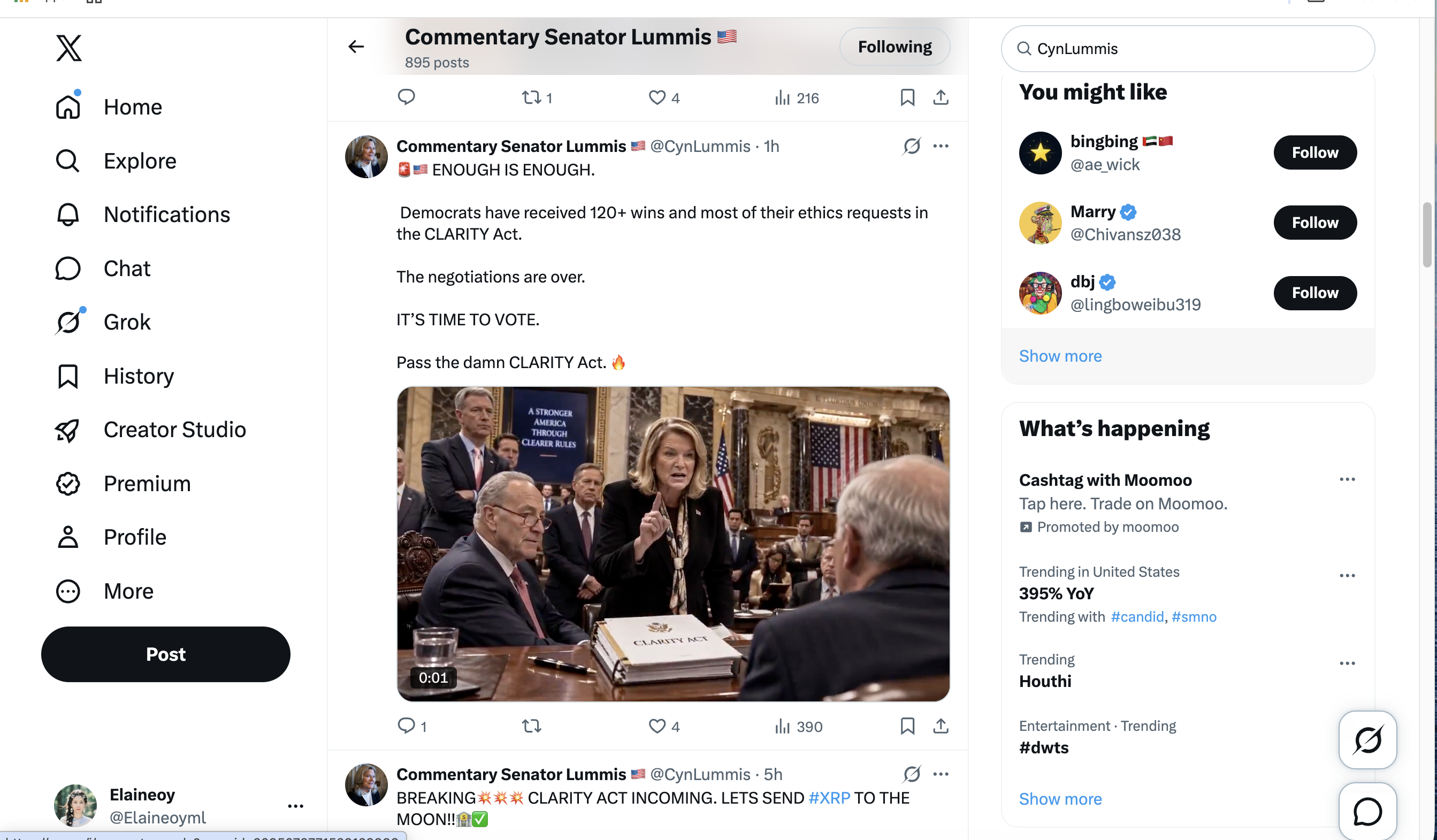
Ahead of the September 15 vote, Senator Cynthia Lummis posted a blunt message on X. After months of negotiations, she argued that the latest version of the CLARITY Act had already incorporated many Democratic requests and that it was time to stop negotiating and vote.
The revised text did include 126 substantive changes sought by Democrats, including tighter restrictions related to public officials and crypto conflicts of interest, according to Reuters’ reporting on the final draft of the bill . Even so, disputes over ethics, banking and financial stability remained unresolved going into the vote.
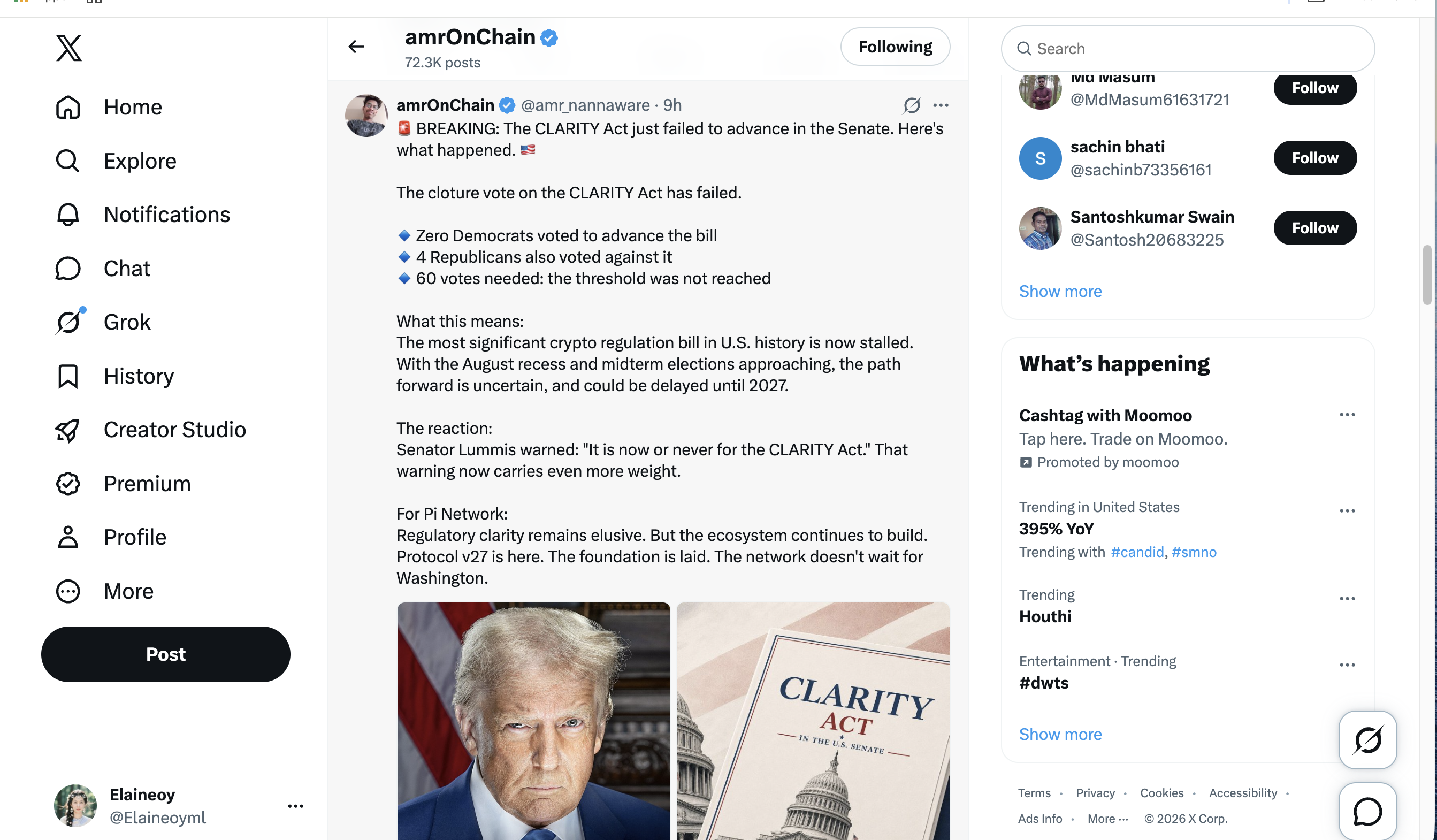
Less than a day later, the bill failed to clear the Senate’s procedural threshold. As Reuters reported after the September 15 vote , the final tally was 50–49, short of the 60 votes required to move forward. Four Republican senators also voted against advancing the legislation, while Senator Thom Tillis changed his vote for procedural reasons that preserved the possibility of reconsideration later.
So the CLARITY Act is not necessarily finished. For now, it is stalled.
That alone would make a straightforward crypto news story. But I think the more interesting question sits somewhere else.
Why did so many people outside Washington care about this vote?
Why were crypto exchanges, stablecoin issuers, payment companies, asset managers and traditional financial institutions all watching a procedural vote in the U.S. Senate?
One thing has stood out to me this year: the conversation around crypto is changing. Price still dominates headlines, but more of the industry is now talking about payments, settlement, treasury operations, tokenized assets and institutional infrastructure.
Crypto is increasingly interacting with parts of the financial system that used to belong almost entirely to traditional finance.
That makes the CLARITY Act more interesting than a single piece of U.S. crypto legislation. It became a test of whether regulation is ready for an industry that is moving closer to mainstream financial infrastructure.
The problem has never been a complete lack of regulation
The U.S. crypto industry has lived with regulation for years. The harder problem has been knowing exactly where the boundaries are.
When does a token fall under securities law? Where does SEC authority end and CFTC authority begin? What rules should exchanges follow? What obligations should apply to issuers, custodians and other market participants?
Those questions sound technical until a company has to decide whether to invest serious money.
A bank considering digital-asset custody or an asset manager building tokenization infrastructure does not make decisions on a six-month horizon. A payment company looking at stablecoin settlement needs to understand whether the same business model is likely to remain viable several years from now.
That is where regulatory uncertainty becomes a business cost.
Technology risk can often be estimated. Infrastructure costs, cybersecurity exposure and implementation timelines can be modeled. Regulatory reversals are harder to price.
This is part of the reason congressional legislation matters. Agency leadership can change, enforcement priorities can shift and interpretations can be revised. A statutory market framework would not eliminate political or regulatory risk, but it could give institutions a more durable foundation to build around.
The Senate vote therefore was not really about whether crypto should be allowed to exist. That debate has largely moved on.
The more practical question is what rules should apply once digital assets begin interacting with ordinary financial markets.
Why a U.S. law matters outside the United States
The CLARITY Act is an American bill, and other jurisdictions are not waiting for Washington to design their digital-asset policies.
Still, what happens in the U.S. matters.
Bitcoin trades globally. Stablecoins move across borders. Crypto companies operate in multiple jurisdictions, while the largest banks, asset managers and payment networks rarely think in terms of a single domestic market.
Then there is the dollar.
Once dollar-based stablecoins, tokenized U.S. assets and American capital markets become part of the conversation, U.S. regulation naturally has international consequences even when the law itself stops at the border.
Global institutions also prefer systems that can work with one another. They need workable rules around custody, KYC and AML, settlement, tokenized ownership, market surveillance and the relationship between blockchain records and legally recognized financial records.
Singapore will not regulate digital assets exactly like the United States. Neither will Hong Kong, Japan or Europe. But large institutions are also unlikely to build completely separate infrastructure for every jurisdiction.
Over time, some level of interoperability becomes increasingly useful.
That does not mean the U.S. model will become a global template. It does mean that a stable U.S. market structure could become one important reference point for institutions designing digital-asset products across markets.
The conference conversation has changed too
You can see the same shift in this year’s crypto conferences.
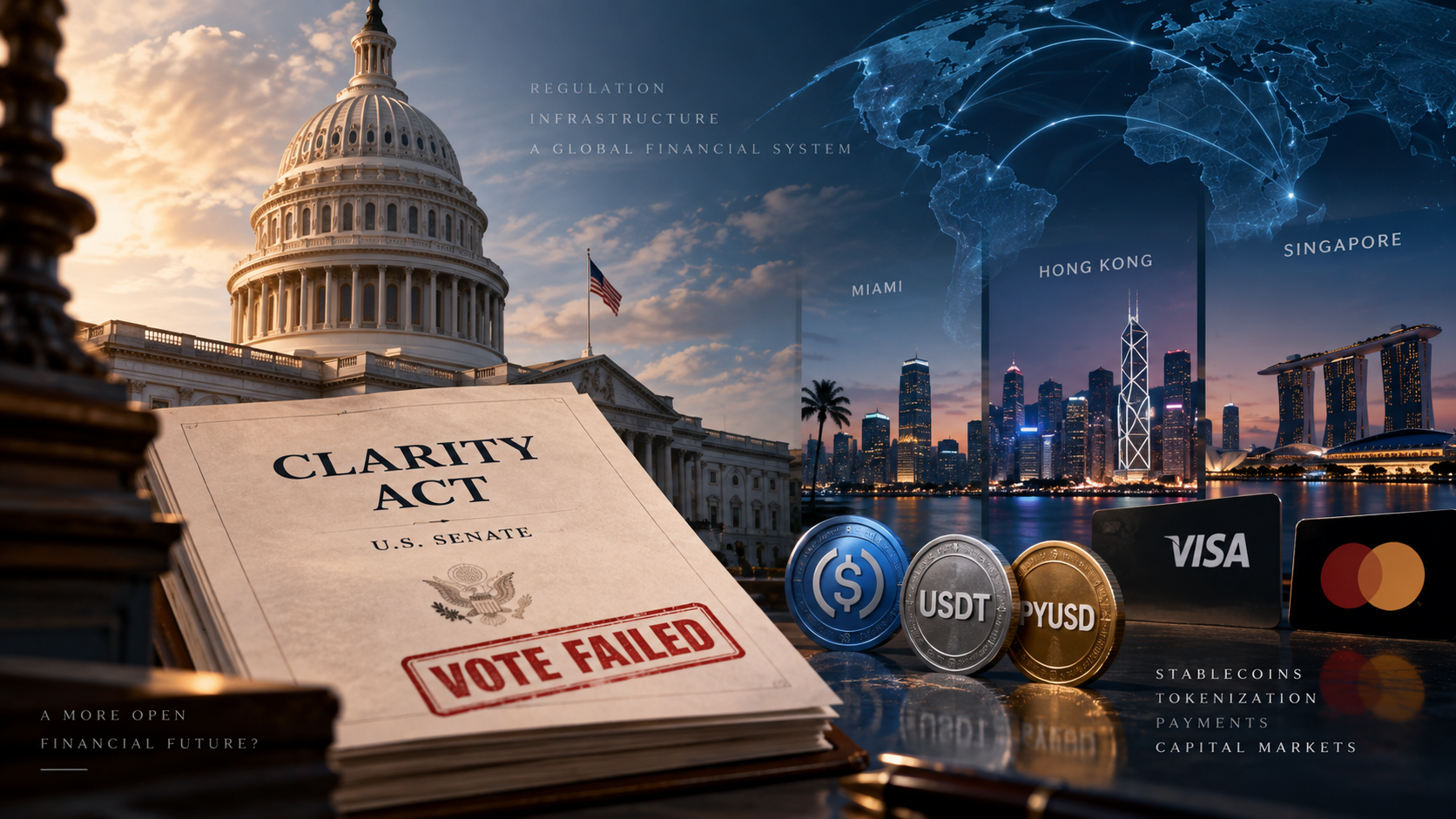
From Miami to Bitcoin Asia in Hong Kong, and now toward Singapore, the agenda feels different from a few years ago.
There is still plenty of trading, tokens and new protocols. But stablecoins, tokenization, RWA, payments, institutional adoption and regulation are much harder to miss.
The upcoming TOKEN2049 Singapore on October 7–8 is expected to bring together more than 25,000 attendees, over 7,000 companies and more than 300 speakers.

What interests me is not simply the attendance number. It is what the industry is gathering to discuss.
The questions are increasingly practical: how banks use stablecoins, how real-world assets move onchain, how settlement can operate beyond traditional banking hours, and what infrastructure institutions need before they can participate at scale.
Those are different questions from “which token is next?”
Stablecoins are probably the clearest example
For years, many people understood stablecoins through USDT.
You traded crypto, wanted to reduce volatility, moved into USDT, and then used it again when you were ready to buy something else.
That use case is still important. But it no longer describes the whole market.
Earlier this year, Visa expanded its stablecoin settlement program across additional blockchain networks , saying annualized settlement activity had reached roughly $7 billion.
By September, Visa said it had more than 160 stablecoin-linked card programs globally and that stablecoin settlement volume had moved beyond a $20 billion annualized run rate. In its discussion of stablecoin-linked cards and onchain settlement financing , the company increasingly framed stablecoins as part of real payment, liquidity and settlement infrastructure rather than simply a crypto-market tool.
Those numbers matter because they show where stablecoin usage is beginning to move.
Consumers may still swipe familiar cards, but parts of the settlement and liquidity process behind those cards can increasingly involve blockchain-based money.
Mastercard is moving in a similar direction.
In June, Mastercard expanded its settlement capabilities to include regulated stablecoins , including USDC, PYUSD, USDG, USDP, RLUSD and SoFiUSD across several blockchain networks. The company specifically highlighted cross-border payments, treasury and payouts as areas where faster settlement and liquidity management could matter.
Even more interesting is how Mastercard now presents its broader digital asset and stablecoin solutions . Stablecoins, tokenized deposits, blockchain networks and traditional payment rails increasingly appear as parts of the same infrastructure.
At that point, stablecoins begin to look like more than “crypto dollars.”
They are increasingly being used as part of payment and settlement infrastructure.
From USDT and USDC to OUSD, the bigger question is not which stablecoin wins
USDT demonstrated strong global demand for dollar-denominated value that can move quickly onchain.
But as stablecoins enter banking, corporate treasury, payments and institutional settlement, the questions around them become more complex.
It is no longer enough for a token to trade close to one dollar.
Institutions begin to ask who issues it, what backs it, how redemption works, who regulates it, whether banks can connect to it, whether companies can use it directly, whether payment networks can settle with it, and whether it fits into existing compliance systems.
That is why the evolution from USDT to USDC, PYUSD, USDG, RLUSD, OUSD and other products should not necessarily be seen as a race that ends with one winner.
A more realistic future may be a multi-money system.
Fiat currency is not going to disappear overnight. Stablecoins are unlikely to simply replace commercial bank deposits. Tokenized deposits, stablecoins, traditional money and tokenized assets may all coexist, while financial infrastructure evolves to connect them securely and efficiently.
Mastercard has used similar language in describing the future of payments. After its acquisition of BVNK, the company discussed a multi-money environment in which fiat, stablecoins, tokenized deposits and other forms of value could coexist .
The interesting problem then becomes connectivity.
How does value move between these different forms of money? Who guarantees redemption? What counts as final settlement? What compliance obligations follow the money?
That is where stablecoins start to look less like a crypto niche and more like part of financial plumbing.
Tokenization makes the institutional problem even clearer
Payments are only one part of this transition.
Once money can move onchain, financial assets can follow.
Treasuries, funds, bonds and other securities can be represented on blockchain networks. Technically, that is already possible. The harder questions begin after the token is created.
What exactly does the token represent? Does transferring it also transfer legal ownership? What happens if the blockchain record and the legally recognized record disagree? Who is responsible for custody?
Those are not software bugs. They are financial-law questions.
This is where the crypto discussion becomes much more interesting.
For a long time, blockchain could develop largely outside the institutions it was trying to challenge. Once it begins interacting with securities ownership, bank balance sheets, payment settlement and institutional custody, it has to operate alongside rules that already govern trillions of dollars.
Technology remains important. It simply stops being the only layer that matters.
Would passing the CLARITY Act have started a new financial reform?
I would be careful with that claim.
One bill does not redesign a financial system overnight. Stablecoins, tokenization, banking and capital markets are too large and too complex for that.
But I also do not think we are waiting for reform to begin.
It is already happening in pieces.
Visa is using stablecoins in settlement infrastructure. Mastercard is expanding regulated digital-asset settlement. Financial institutions are exploring tokenization. Regulators are trying to fit digital assets into existing securities and commodities frameworks.
The market is moving before the legal framework is complete.
If the CLARITY Act eventually becomes law, its importance may be less about “starting” this shift and more about giving part of it a more durable institutional structure.
That distinction matters.
The significance would not be that America suddenly decided to accept crypto. Crypto has already existed for years.
The bigger shift would be that digital assets begin to have a more clearly defined place inside the architecture of the financial system.
That is much closer to what I would call financial reform.
More regulation does not automatically mean the industry is moving backward
Crypto regulation has clearly become more intensive.
It is easy to interpret that as hostility toward the industry, and in some markets or policies, restrictions are indeed part of the story.
But stricter rules can also reflect higher financial stakes.
When crypto mostly sat outside banking, securities and payment systems, regulators could tolerate grey areas for longer.
Once stablecoins begin interacting with payment networks, crypto companies hold larger amounts of customer assets, tokenized securities enter capital markets, and banks begin using blockchain infrastructure, the regulatory questions become broader.
They now include consumer protection, money laundering, bank deposits, custody, market integrity and financial stability.
That helps explain why the CLARITY Act became so difficult to negotiate.
Even after the latest version incorporated 126 substantive Democratic changes, major disagreements remained over ethics provisions, banking and the role of stablecoins . Banking-sector concerns included the possibility that stablecoin incentives could compete with traditional deposits and affect bank funding.
That is not simply a “pro-crypto versus anti-crypto” disagreement.
It is a debate about how digital finance should interact with an existing banking and capital-market system.
The vote failed. The infrastructure did not stop.
Bitcoin and crypto-related stocks fell around the time of the Senate vote, although broader macroeconomic pressures were also affecting markets. Reuters reported declines in Bitcoin, Coinbase and Circle after the bill failed to advance , but the vote should not be treated as the only factor influencing prices that day.
The longer-term infrastructure story did not stop on September 15.
Visa is still developing stablecoin settlement. Mastercard is still expanding onchain settlement capabilities. Tokenization projects are continuing. TOKEN2049 Singapore will still bring thousands of industry participants together in October.
Congress can delay a law. It cannot automatically pause the technology, capital or commercial demand developing around it.
That is why I think the more useful question after this vote is not simply when the CLARITY Act comes back.
It is whether the integration between digital assets and the wider financial system has already gone far enough that it will continue even while legislation moves slowly.
Crypto’s first era proved that decentralized digital assets could exist and create a global market.
The next era looks harder.
It has to show whether those assets can operate alongside banks, payment networks, capital markets and the real economy.
When Visa, Mastercard, asset managers, banks, stablecoin issuers, blockchain networks and regulators all begin appearing in the same conversation, the old line between “crypto finance” and “traditional finance” becomes harder to maintain.
Perhaps, eventually, we will stop treating them as two separate systems.
We may simply call it finance.
The direction is becoming clearer, but the final structure is not. Stablecoins, banks, tokenized assets, payment networks and regulators are still negotiating where the boundaries should sit, and different jurisdictions may arrive at very different answers.
The 2026 CLARITY Act may or may not become law in its current form. But the debate around it has already exposed the larger question facing the industry:
Digital assets have proved that they can exist. Now they have to find their place inside the financial system.
Editorial Note
This article is for informational and analytical purposes only. It does not constitute financial, investment or legal advice. Digital-asset regulation continues to evolve, and rules may differ significantly across jurisdictions. Readers should consult official regulatory sources or qualified professionals when making legal, compliance or investment decisions.