
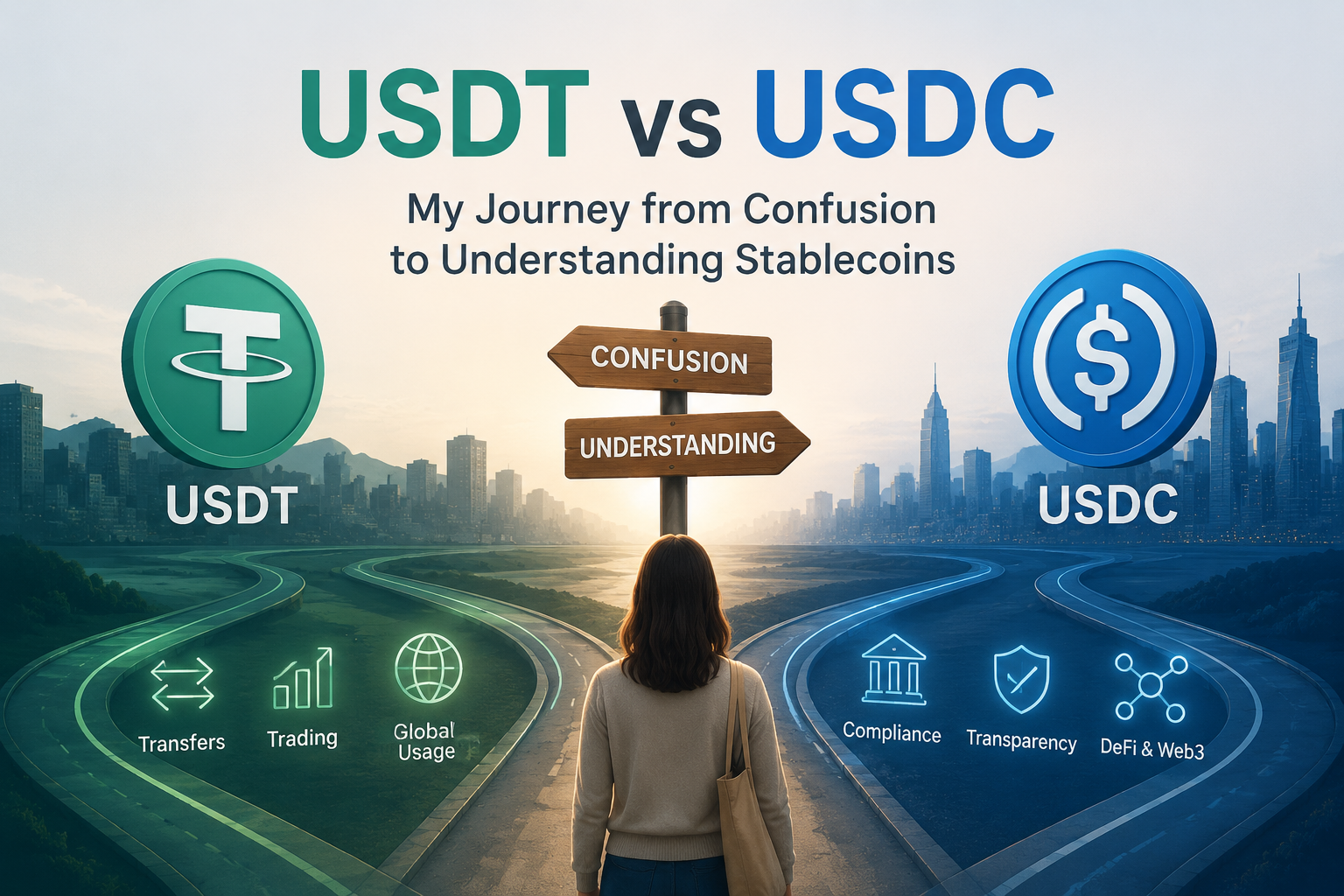
A few months ago, if someone had asked me what the difference was between USDT and USDC, my answer probably would have been:
“Aren’t they both stablecoins? What’s the difference?”
I think that’s how many beginners see them.
Both are designed to stay close to one US dollar. Both can be used for transfers, trading, and storing value. When you first open an exchange account, they look almost identical.
But as I spent more time learning about crypto, I slowly realized that people choose USDT and USDC for very different reasons.
How I ended up here
I didn’t start learning about crypto because I wanted to trade. What pulled me in was a mix of work, curiosity, and a desire to understand technologies that more and more people were talking about.
For years, my world revolved around products, customers, websites, and orders. Terms like blockchain, wallets, and stablecoins felt distant. Then I opened exchange accounts, started transferring funds, and discovered something I hadn’t expected: in many cases, the most frequently used assets in crypto aren’t Bitcoin or Ethereum. They’re stablecoins.
Tether’s USDT was the first one I encountered. Looking back, part of why it felt easy to trust was simple: the name. USDT is one letter away from USD, and somehow that creates familiarity. It may not be a logical reason, but that’s often how confidence works when you’re learning something new.
As I explored further, USDT seemed to be everywhere — most trading pairs on Binance, Bybit, and other exchanges involved it. Many users preferred transferring on the TRC20 network because fees were low and support was wide. I assumed USDT was simply the standard answer when people talked about stablecoins.
When I realized stablecoins were about more than trading
The longer I stayed in the crypto space, the more I noticed stablecoins appearing outside of it.
Some Web3 wallets I use support sending and receiving stablecoins directly. For people involved in international business, remote work, or cross-border transactions, stablecoins are gradually becoming a tool for moving value across the internet. That changed how I thought about them.
I started realizing that discussions about stablecoins weren’t really about crypto speculation. They were conversations about digital dollars, internet-native payments, and how money might move around the world in the future.
That was the moment I became interested in understanding the logic behind them.
Why USDC kept appearing
As I continued learning, I kept seeing another name: USDC. At first I didn’t pay attention — to a newcomer, all stablecoins look more or less the same.
But after reading more about DeFi and on-chain applications, I noticed that people were actively choosing USDC, often for reasons that had nothing to do with price.
Circle , the issuer of USDC, has consistently emphasized transparency, compliance, and regulatory cooperation, which helps explain why it’s widely used in institutional and DeFi environments. USDT, on the other hand, benefits from being one of the earliest and most widely adopted stablecoins — making it the default for many traders and international users.
The choice between them is rarely just technical. It often depends on where you live, how you use digital assets, and what risks you’re comfortable with.
What learning about stablecoins actually changed
In the beginning, I paid attention to the same things most people notice: prices, market movements, and headlines about gains and losses.
Over time, I found myself more interested in different questions.
What problems does this technology actually solve? Why are people choosing to use it? How can value move across borders without relying entirely on traditional financial systems?
Those questions became far more interesting to me than daily price charts.
Of course, stablecoins aren’t without controversy. Governments and regulators around the world are still deciding how digital assets should fit into existing financial systems. The US, EU, Hong Kong, and Singapore have all introduced or developed frameworks related to stablecoins in recent years — and the conversation is far from settled.
So, USDT or USDC?
Neither is universally better. They serve different purposes.
If you’re frequently moving funds between exchanges, USDT may be more convenient. If you’re exploring DeFi or certain on-chain ecosystems, USDC tends to appear more often.
A year ago, I thought stablecoins were a small side story in crypto. Today, they might be the first blockchain application I truly understand.
And they’ve left me with a question I hadn’t seriously considered before: as more payments, commerce, and financial activity move onto the internet, what will money actually look like in the future?
Many new ideas begin with a question like that.
Sources: Tether · Circle · CoinDesk · CoinMarketCap
Disclaimer: This article reflects my personal learning journey and observations. It is not investment, legal, or financial advice. Regulations surrounding digital assets and stablecoins vary by country and region. Please do your own research before using related products or services.