
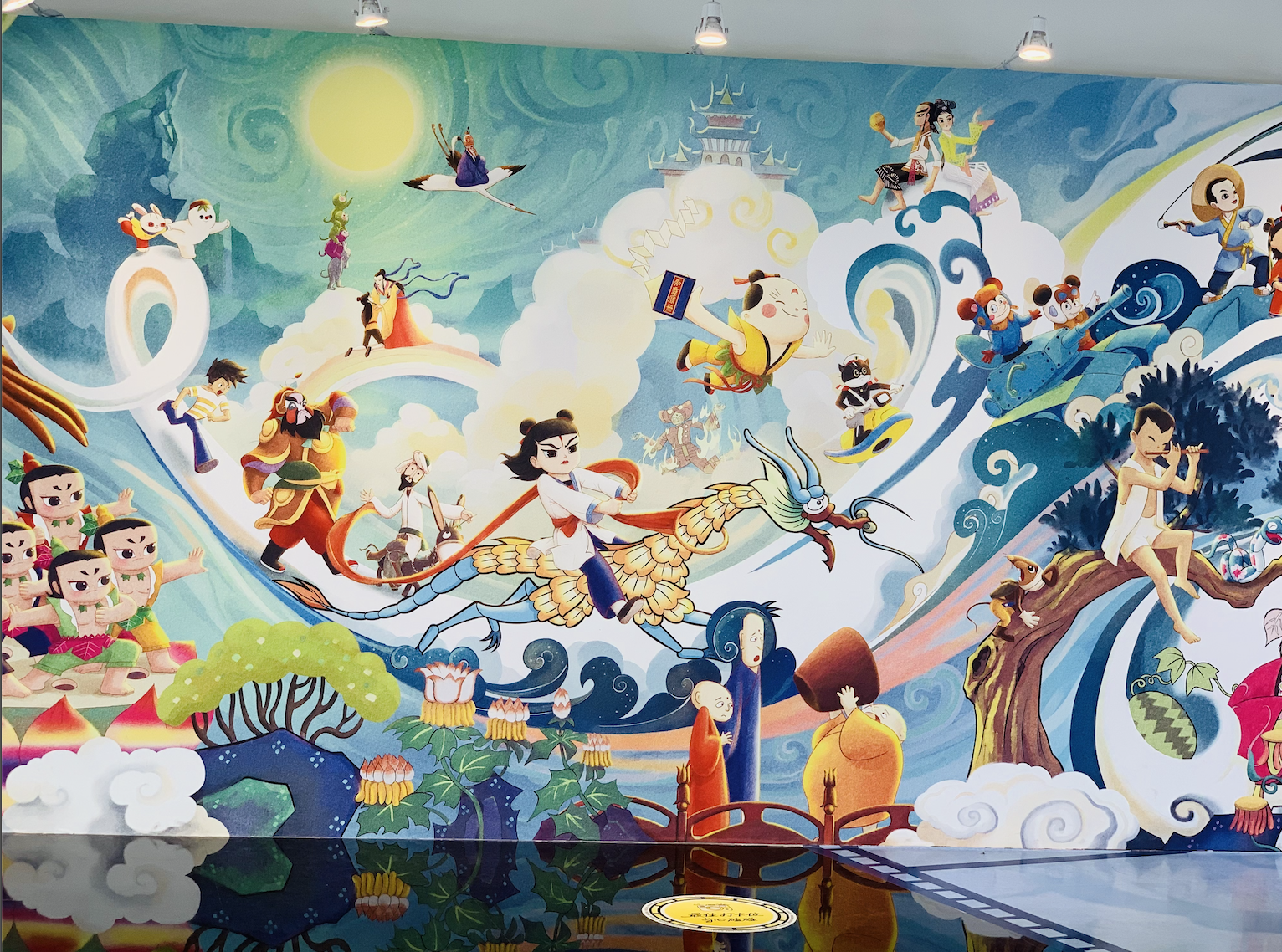
An exhibition of classic Chinese animation brought back memories of my childhood and reminded me how much beauty there is still to discover in our own cultural heritage.
Today, I took my son to an exhibition featuring classic animations created by the Shanghai Animation Film Studio.
As I walked through the exhibition and saw those familiar animated characters again, memories of my childhood began to return. Where Is Mama?, Havoc in Heaven, Calabash Brothers, and, of course, Black Cat Detective, the brave black cat who would raise his pistol whenever the words “To Be Continued” appeared at the end of an episode.
What surprised me even more was how naturally the music returned to my mind. I hadn’t deliberately listened to some of those theme songs for years, yet the moment I saw the characters, their familiar melodies seemed to start playing in my head. I could almost picture myself sitting in front of the television again, eagerly waiting for my favorite cartoons to begin.
Looking at these animations through the lens of modern technology, it’s easy to recognize the limitations of their time. Today’s digital animation offers more sophisticated visual effects, smoother movements, and possibilities that earlier generations of animators could hardly have imagined. But none of that changes what these films mean to me. They may not have had today’s advanced technology, but they were part of my childhood, bringing me happiness and accompanying me as I grew up.
What makes them even more special is that some of these works were already being watched when my mother was young. They later became part of my own childhood, and now, decades later, I was standing in an exhibition hall with my son, introducing him to the same animated characters.
It was a small reminder that a story can sometimes travel through generations, connecting people who grew up in very different worlds.
And the world my son is growing up in is certainly different from mine.
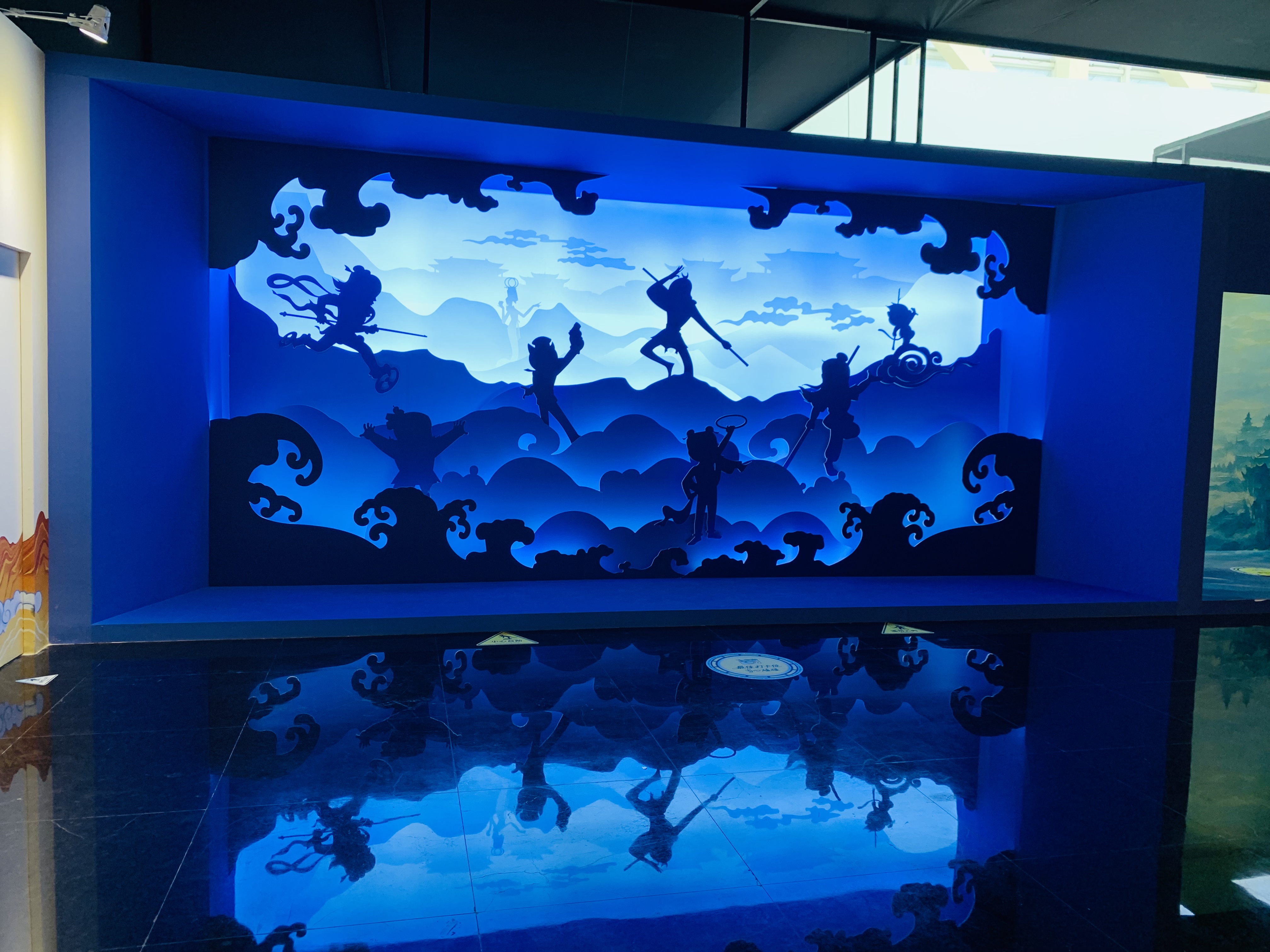
The Animated Worlds Once Created by Hand
Founded in 1957, the Shanghai Animation Film Studio holds an important place in the history of Chinese animation. Its name may not be familiar to every international audience, but many of the films it produced became treasured childhood memories for generations of Chinese viewers.
When I was little, I never thought much about how cartoons were made. I cared about whether Sun Wukong could defeat the heavenly soldiers, whether the seven Calabash Brothers could overcome the villains, and what new mystery Black Cat Detective would solve in the next episode.
The stories were exciting, the characters were memorable, and that was enough.
Returning to these works as an adult, however, I found myself paying attention to something I had barely noticed as a child: the art behind the animation.
Before digital drawing software and computer-generated animation became widely available, creating an animated film required an enormous amount of manual work. Characters, backgrounds, costumes, and movements had to be carefully designed, drawn, or constructed, while many productions relied on frame-by-frame photography to bring their stories to life.
Yet what makes the Shanghai Animation Film Studio particularly interesting is not simply the amount of work involved. It is the way its artists explored the possibilities of animation through traditional Chinese artistic forms.
Chinese ink painting, meticulous brushwork, paper cutting, puppetry, traditional opera, and ancient murals all became sources of inspiration.
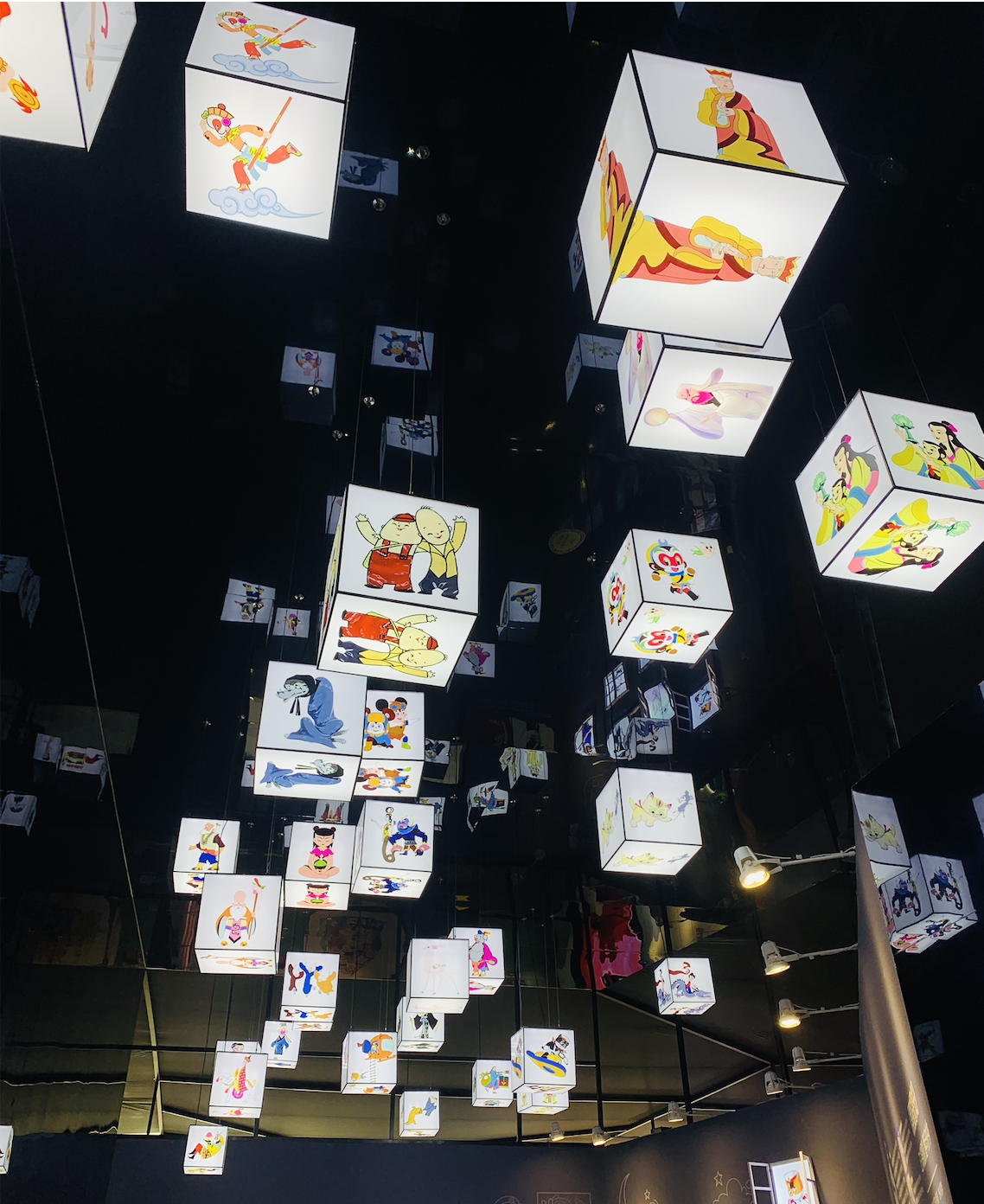
Art forms that had existed for centuries on paper, silk, theater stages, and temple walls found new expressions on screen.
Looking back, I realize that many of the cartoons we watched as children were much more than entertainment. They were also experiments in bringing traditional Chinese aesthetics into the modern art of filmmaking.
Havoc in Heaven: A Monkey King Inspired by Traditional Chinese Art
One of the most recognizable works produced by the Shanghai Animation Film Studio is Havoc in Heaven (Da Nao Tian Gong).
Directed by Wan Laiming and completed in two parts in 1961 and 1964, the animated feature was adapted from Journey to the West, one of China’s great classical novels.
Its main character, Sun Wukong, also known as the Monkey King, is among the most familiar figures in Chinese mythology and literature. Armed with a magical staff and gifted with extraordinary powers, he is mischievous, courageous, and unwilling to submit easily to authority.
For many Chinese children, Sun Wukong is a character they grow up knowing, even before they are old enough to read the original novel.
But what makes Havoc in Heaven so distinctive is not merely its famous story.
The film’s character designs, costumes, architecture, clouds, and decorative patterns draw inspiration from traditional Chinese painting and ornamental art. Sun Wukong’s expressive movements also reflect the influence of Chinese opera, particularly its stylized gestures and dramatic physical performance.
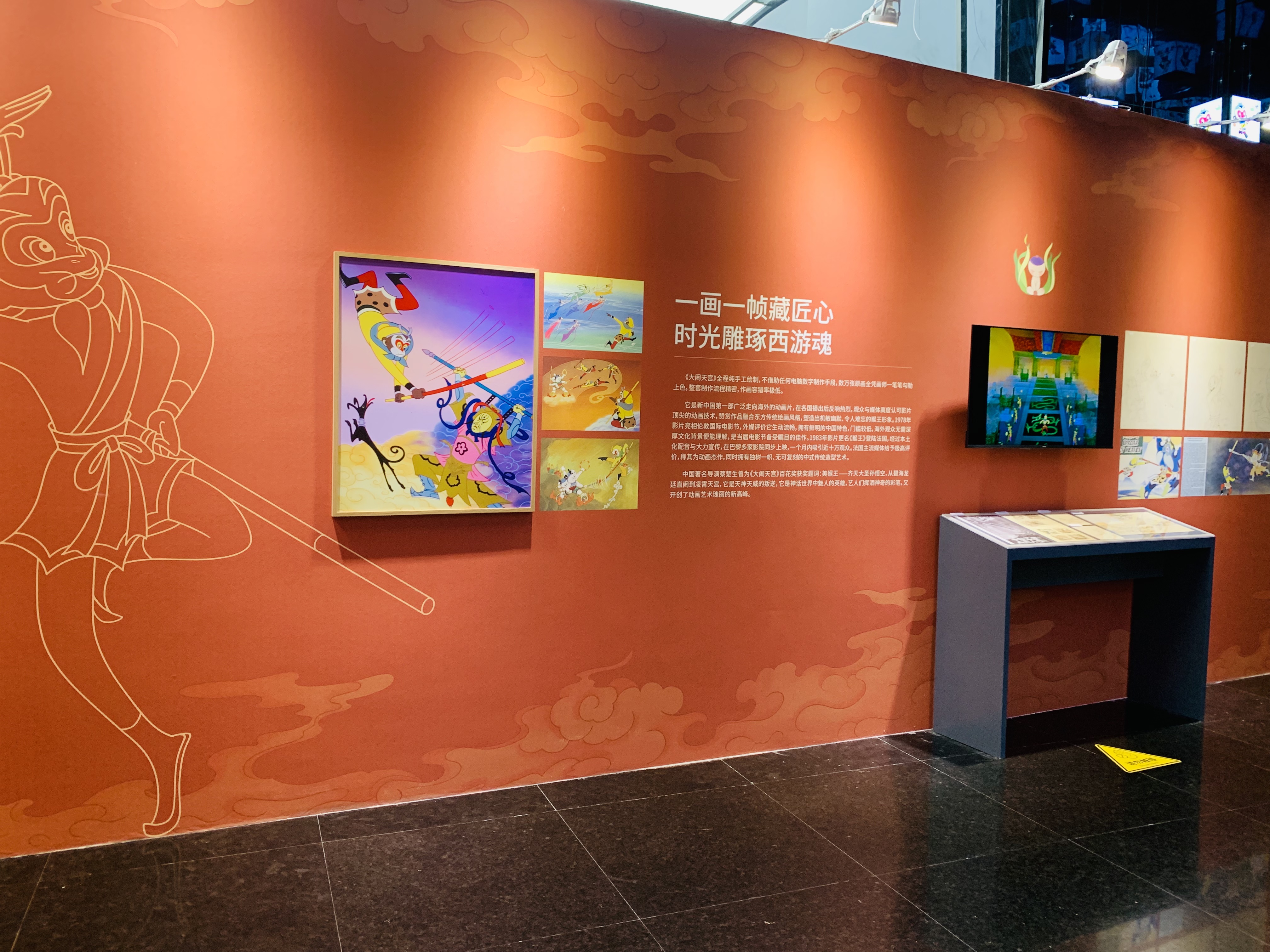
The heavenly palaces, with their elaborate roofs, colorful architectural details, and swirling clouds, create a fantasy world shaped by a distinctly Chinese visual imagination.
Rather than simply illustrating the events described in an ancient novel, the artists developed a complete artistic language for the film.
Watching it today, I find it fascinating how an old story can take on different forms through literature, opera, painting, and animation. Each medium offers another way of experiencing the same characters and their adventures.
For me, Havoc in Heaven is a wonderful example of how traditional artistic elements can find new life through modern creative techniques.
Where Is Mama?: When Chinese Ink Paintings Began to Move
Another part of the exhibition that particularly interested me was Chinese ink animation.
Traditional Chinese ink painting has a very different visual character from many other painting traditions. Artists use variations in ink density, expressive brushstrokes, and carefully considered empty spaces to suggest movement, atmosphere, and emotion.
A few strokes may be enough to convey the movement of a fish, the delicacy of a plant, or the vastness of a mountain landscape.
But what would happen if the fish in an ink painting could actually swim?
In 1960, the Shanghai Animation Film Studio released Where Is Mama? (Xiao Kedou Zhao Mama), an early masterpiece of Chinese ink animation.
Inspired by the artistic style of renowned Chinese painter Qi Baishi, the film brought fish, tadpoles, frogs, and aquatic plants to life through an animation technique designed to preserve the visual qualities of traditional ink painting.
As a child, I simply followed the little tadpoles as they searched for their mother. I never wondered why the images looked so different from those in other cartoons.
Only much later did I begin to appreciate how unusual the film really was.
One of the defining characteristics of Chinese ink painting is the natural variation of ink on paper. Its edges can appear soft and diffused, while different concentrations of ink create subtle transitions in tone.
Reproducing these qualities consistently in moving images presented a considerable technical challenge. Animation requires a sequence of images that work together smoothly, while traditional ink painting often depends on effects that are difficult to reproduce precisely.
The studio’s artists and technicians developed specialized processes to make these moving ink images possible.
Their achievement was not simply making an ink painting move, but preserving something of the original art form’s character in the process.
Later works, including The Cowboy’s Flute (Mu Di) and Feeling from Mountain and Water (Shan Shui Qing), explored the artistic possibilities of ink animation even further.
Released in 1988, Feeling from Mountain and Water combines traditional Chinese landscape painting with guqin music, a classical Chinese musical tradition associated with the seven-string zither.
Through mountains, flowing water, carefully composed images, and moments of visual stillness, the film communicates emotion without depending on elaborate dialogue or a complicated plot.
It represents a way of storytelling in which painting, music, rhythm, and silence work together.
I find this especially beautiful because it reminds me that art does not always need visual complexity to express something meaningful. Sometimes a few lines, changing shades of ink, or an intentionally empty space can create an atmosphere that stays with us long after the image disappears.
From Paper Cutting to Dunhuang: Traditional Art in Chinese Animation
Ink painting was only one of the artistic traditions explored by the Shanghai Animation Film Studio.
Its artists also experimented with paper-cut animation, puppetry, and other forms inspired by Chinese folk art.
In 1958, the studio produced Zhu Bajie Eats Watermelon, regarded as China’s first paper-cut animated film.
Paper cutting has a long history in Chinese folk culture. Using paper and scissors, artists create decorative patterns featuring people, flowers, animals, and symbols associated with celebrations and good fortune.
These designs are often used to decorate homes during traditional festivals, but their artistic value extends beyond decoration. Their shapes, symmetry, colors, and patterns reflect generations of craftsmanship and imagination.
Transforming paper cutting into animation required a different approach from conventional hand-drawn filmmaking.
Artists had to design movable figures, carefully arrange their joints, and adjust their positions frame by frame so that the flat paper characters could perform actions and tell stories.
Years later, the studio produced another work that became deeply familiar to Chinese children: Calabash Brothers (Hu Lu Xiong Di).
First released in 1986, the series follows seven brothers born from magical calabashes, each possessing a different extraordinary ability.
When I was little, I was fascinated by the brothers’ powers and their adventures against the villains. I hardly noticed the distinctive visual qualities of the paper-cut animation.
Looking at the characters now, I pay much more attention to their shapes, colors, costumes, and decorative designs.
Another film I would particularly like international readers to discover is The Nine-Colored Deer (Jiu Se Lu).
Released in 1981, the animated short was inspired by the story depicted in the Ruru Jataka mural in Cave 257 of the Mogao Caves in Dunhuang, China.
The original mural dates to the Northern Wei period, more than a thousand years before the animated film was created.
The film’s artists studied the ancient murals and incorporated elements of their character designs, clothing, colors, and visual compositions into the animation.
What I find remarkable is this connection across time.
The Mogao Caves preserve an extraordinary collection of murals and sculptures created over many centuries. They also reflect the cultural exchanges that took place along the Silk Road, where artistic influences, religious traditions, and stories traveled between different regions.
The paintings contain an abundance of artistic details, from flowing garments and expressive human figures to elaborate architectural settings and richly colored landscapes.
Through The Nine-Colored Deer, a story once painted on the walls of a cave became an animated film that could reach audiences far beyond Dunhuang.
A child watching the film might know nothing about the history of the Mogao Caves or the artistic traditions of the Northern Wei dynasty. They may simply be captivated by the beautiful deer and its story.
But perhaps years later, when they encounter a photograph of the Dunhuang murals or visit a museum displaying related artwork, something will feel familiar.
That is one of the things I appreciate about animation. It can make cultural history approachable without requiring the audience to understand all of its historical background first.
Sometimes, a story is where curiosity begins.
As We Discover the World, How Much Do We Know About Our Own Culture?
Visiting the exhibition also reminded me of something I have been thinking about for a while.
We live in an age when discovering cultures from around the world has become remarkably easy.
Children grow up watching Japanese animation, American films, and stories created in countries their parents may never have visited. Through the internet, they can become familiar with characters, music, games, and cultural traditions from almost anywhere.
My son loves Ultraman, the Japanese superhero who has entertained generations of children. I have never considered this a problem. On the contrary, I am glad he has opportunities to experience stories and ideas from different cultures.
I feel the same way about my own life.
I enjoy discovering new things, learning about emerging technologies, and exploring different approaches to art, design, and everyday living.
There is so much to learn from the world, and I have always valued the freedom to remain curious about it.
But as I walked through the exhibition, another question came to mind.
While we are becoming increasingly familiar with cultures from other parts of the world, how much time do we spend discovering the artistic traditions that have existed within our own culture for centuries?
Many people around the world recognize Leonardo da Vinci and Vincent van Gogh. Paintings such as the Mona Lisa and The Starry Night are widely known, and their artists continue to inspire people far beyond the places where they lived.
Chinese art also has a long and extraordinarily rich history, although many of its masterpieces may be less familiar to international audiences.
Take The Nymph of the Luo River (Luo Shen Fu Tu), traditionally associated with the fourth-century Chinese painter Gu Kaizhi. The versions preserved today are later copies, but they still offer a fascinating glimpse into the development of Chinese figure painting and visual storytelling.
Through flowing lines, landscapes, and carefully arranged figures, the painting interprets a literary story about love and separation.
Or consider A Thousand Li of Rivers and Mountains (Qian Li Jiang Shan Tu), created during the Northern Song dynasty by the young painter Wang Ximeng.
Its sweeping landscape, brilliant blue-green mineral pigments, mountains, rivers, bridges, and pavilions reveal an extraordinary approach to representing nature.
Then there are the murals of the Mogao Caves, with their expressive figures, flowing garments, intricate details, and artistic styles shaped across different dynasties.
And these examples represent only a small part of Chinese artistic heritage.
Calligraphy, landscape painting, meticulous brush painting, ceramics, wood carving, traditional architecture, and folk crafts all have their own histories, techniques, and ways of expressing beauty.
I am certainly not an art historian, and there is still a great deal I do not know.
Perhaps that is one reason I enjoy visiting exhibitions. The more I discover, the more I realize how much remains to be explored.
I do not believe that appreciating one culture requires rejecting another, nor do I think traditional art should automatically be considered better than modern creative work.
Every era develops its own artistic language, and new forms of expression continue to emerge.
What matters to me is having the opportunity to encounter them.
My son can enjoy Ultraman while also discovering Sun Wukong. He can love contemporary three-dimensional animation while learning that Chinese artists once developed ways to make traditional ink paintings come alive.
I do not expect him to develop the same interests I had as a child, and I certainly do not want cultural appreciation to become another obligation he must fulfill.
I simply hope he has the opportunity to discover different forms of beauty and decide for himself what inspires him.
Discovering the world and understanding our own cultural heritage have never seemed contradictory to me.
Art Is Something We Can Experience, Not Just Admire
After visiting the exhibition, my son also tried making a bead-art design for the first time.
Watching him carefully arrange tiny colored beads into a pattern reminded me of something I had done during the Mid-Autumn Festival earlier this year.
Instead of buying a ready-made lantern, I decided to gather the materials and make one myself.
There are countless beautiful lanterns available in stores, many of them more polished and professionally finished than anything I could make at home.
But I still wanted to create my own.
I enjoyed thinking about the design, choosing the materials, mixing colors, painting, decorating, and gradually seeing the finished lantern take shape.
The result was not perfect, but that was never particularly important to me.
What I appreciated was the experience of making something with my own hands and expressing a little of my own imagination through it.
I have always enjoyed painting, practicing calligraphy, and occasionally experimenting with different crafts. I am not professionally trained in all these art forms, but that has never stopped me from finding pleasure in them.
Sometimes, I think we make art seem more distant from everyday life than it really needs to be.
Art can be a centuries-old painting preserved in a museum, but it can also be a hand-painted fan, a bookmark decorated with a few brushstrokes, or a lantern made at home for a traditional festival.
Not every creative experience needs to produce a masterpiece.
Sometimes the simple act of trying, experimenting, and making something ourselves is enough.
This thought returned to me as I looked at the classic animations created by the Shanghai Animation Film Studio.
Behind those familiar characters were artists who had to imagine, design, experiment, and solve problems that did not always have obvious solutions.
They explored how to make paper figures move naturally, how to preserve the softness of ink painting in animation, and how to transform ancient mural paintings into stories that could unfold on screen.
Of course, modern technology has dramatically changed the creative process.
Digital tools make many tasks faster and give artists possibilities that previous generations could only have imagined.
But appreciating traditional techniques does not mean rejecting new technology.
In fact, many of the studio’s greatest achievements came from combining traditional artistic ideas with the filmmaking technology available at the time.
Its artists did not insist that ink painting or paper cutting could exist only in their original forms. Instead, they explored how those traditions could be expressed through an entirely different medium.
Today, as new creative technologies continue to develop, I believe there are still many opportunities to explore how traditional arts can inspire new forms of expression.
The tools may change, but curiosity, imagination, and the desire to create remain important.
Allowing More People to Discover the Beauty of Chinese Art
As we left the exhibition, I had no idea how much of what we had seen would remain in my son’s memory.
Perhaps he will continue to prefer contemporary animation. Perhaps he will spend tomorrow excitedly telling me another story about Ultraman, without mentioning any of the classic Chinese cartoons we saw today.
And that is perfectly fine.
What matters to me is that he had the opportunity to encounter something different.
He saw animated characters that had been part of his mother’s childhood and, in some cases, his grandmother’s childhood too. He also discovered that animation could be created through traditional ink painting, paper cutting, puppetry, and artistic styles inspired by ancient Chinese culture.
For me, the exhibition offered something similar.
As a child, I remembered these cartoons for their characters, stories, and music. As an adult, I found myself noticing the artistic details I had once overlooked.
I began to wonder why Sun Wukong’s movements resembled traditional Chinese opera, how the tadpoles in Where Is Mama? could move with the softness of ink on paper, and how a thousand-year-old mural from Dunhuang could inspire an animated film.
I realized that many things we encounter in childhood can reveal entirely different meanings when we return to them later in life.
I hope to continue visiting exhibitions like this, discovering more about Chinese painting, architecture, calligraphy, and traditional crafts, while also exploring art and culture from other parts of the world.
I remain curious about new ideas, new technologies, and different ways of living. I enjoy the openness of a world where cultural exchange is easier than ever before.
At the same time, I want to keep learning about the artistic traditions passed down through generations before us.
China has beautiful paintings, remarkable stories, and distinctive artistic traditions that deserve opportunities to be seen, appreciated, and understood.
They do not need to be compared with other cultures to demonstrate their value. Each artistic tradition has its own history and ways of expressing beauty.
For someone unfamiliar with Chinese art, perhaps a classic animated film could be a wonderful place to begin.
They might discover Chinese mythology through Havoc in Heaven, encounter traditional ink painting through Where Is Mama?, or become curious about the murals of Dunhuang after watching The Nine-Colored Deer.
And perhaps that curiosity will lead them to explore something they had never considered before.
For me, this exhibition was both a reunion with some old childhood friends and an opportunity to rediscover the artistic traditions behind their stories.
When I saw Black Cat Detective again, I could still hear the familiar music in my head. I could still remember the moment he raised his pistol and the words “To Be Continued” appeared on the screen.
Only now, I am no longer the little girl sitting in front of the television, eagerly waiting for the next episode.
Today, I returned to that familiar animated world with my own child.