

Over the past year, I have followed several major crypto conferences, from Miami to Bitcoin Asia in Hong Kong, and now TOKEN2049 Singapore.
What interests me most has gradually changed.
At first, crypto conferences were easy to understand. We watched Bitcoin, regulation, exchanges, new chains, market cycles and, inevitably, price. But the conversations around these events have started to feel broader. AI keeps appearing. Stablecoins are moving deeper into payments. Traditional financial institutions are no longer simply asking whether they should participate in crypto. Increasingly, they are discussing what parts of finance might eventually move onchain.
That is why, before TOKEN2049 Singapore begins on October 7, I am less interested in predicting what Bitcoin will do after the conference than in asking a different question:
What kind of financial system are we moving toward?
A look at the official TOKEN2049 Singapore agenda already suggests that the conversation is expanding beyond crypto as an asset class. Sessions cover stablecoin payments, institutional finance moving onchain, AI agents, DeFi and the broader future of financial infrastructure.
These are no longer only conversations about crypto.
They are increasingly conversations about payments, markets, money and financial infrastructure.
So before the conference starts, these are the questions I want to carry into it.
1. Are stablecoins becoming financial infrastructure rather than simply crypto assets?
For a long time, stablecoins were largely discussed inside the crypto economy.
USDT became essential to global crypto liquidity. USDC developed a strong position around regulated institutions, exchanges and onchain finance. Stablecoins became one of the easiest ways to move dollars between exchanges, wallets and blockchain networks.
But during 2026, the conversation changed noticeably.
Visa has been expanding stablecoin settlement across multiple blockchain networks and positioning stablecoins as part of broader payment and settlement infrastructure. Its own updates on stablecoin settlement show how the company is moving beyond experimentation and into real settlement use cases.
Mastercard has been moving in a similar direction. The company has discussed integrating regulated stablecoins into its payment infrastructure and settlement capabilities, including cross-border payments, payouts and treasury flows. Its broader stablecoin strategy is another sign that stablecoins are no longer being treated only as crypto-native instruments.
This is quite different from simply allowing customers to buy crypto.
The payment networks themselves are beginning to integrate stablecoins into the infrastructure used to move and settle money.
Then, at the end of September, Open USD — OUSD — went live.
OUSD caught my attention not simply because it is another dollar stablecoin. The Open Standard network brings together companies including Coinbase, Mastercard, Shopify, Stripe and Visa, alongside a wider ecosystem of financial and technology partners.
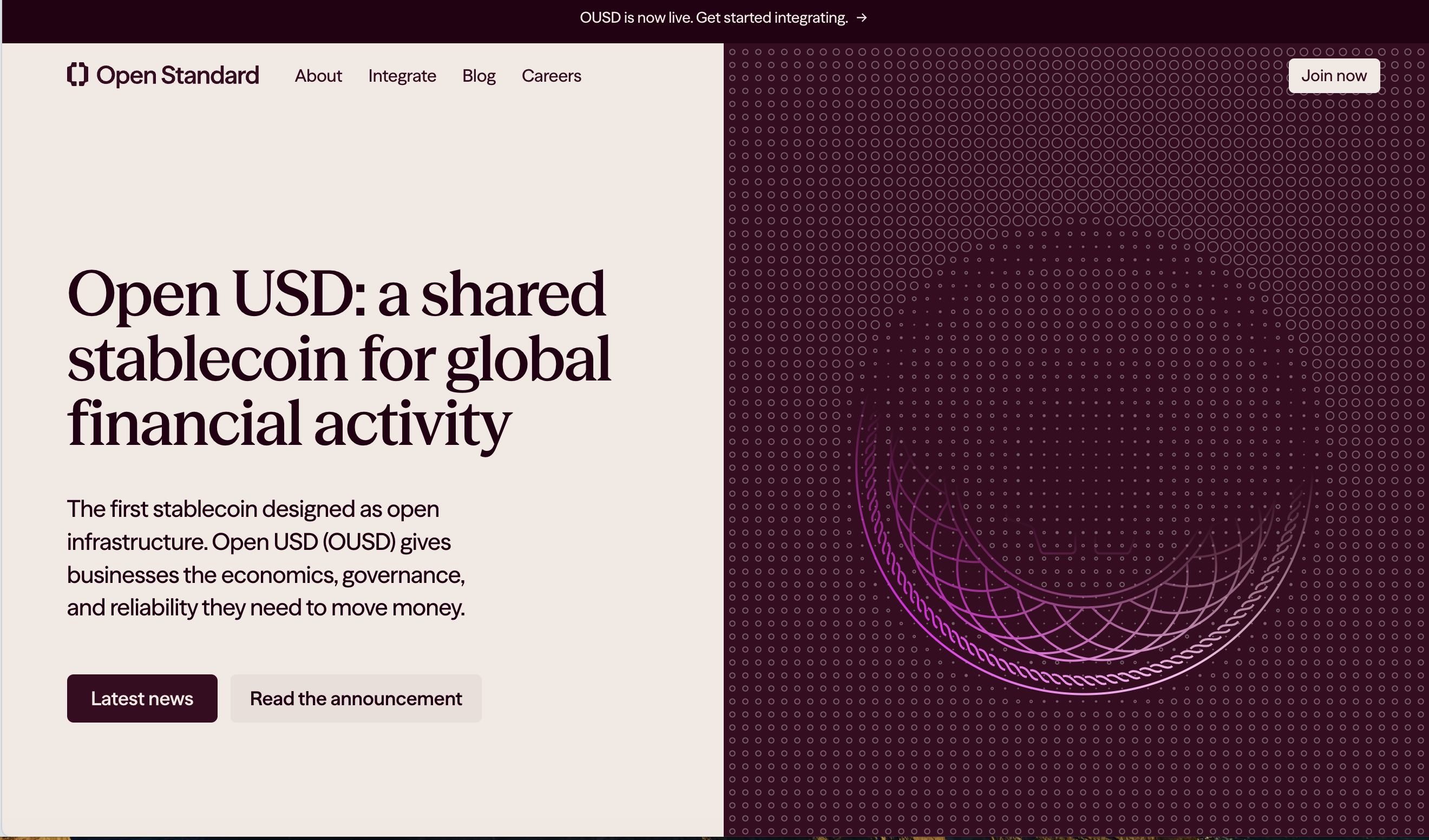
Stripe has also discussed OUSD directly and positioned it as part of its stablecoin infrastructure. Its OUSD announcement is especially interesting because it shows how quickly stablecoins are becoming integrated into products that already sit close to mainstream payments and online commerce.
That makes me wonder whether stablecoin competition itself is entering a different stage.
USDT built enormous liquidity. USDC built a strong institutional and regulatory ecosystem. OUSD appears to be testing another model: distribution through existing financial, commerce and payment networks.
The important question may therefore no longer be simply, which stablecoin will become the biggest?
It may be:
Which stablecoin, or group of stablecoins, becomes embedded deeply enough into payment infrastructure that users no longer need to think about the stablecoin at all?
If TOKEN2049 spends more time talking about settlement, treasury management, merchant payments, cards and cross-border money movement than about stablecoin trading liquidity, that will be one signal worth watching.
2. Why does almost every major crypto conference now end up talking about AI?
Another pattern has been difficult to ignore this year.
From Miami to Hong Kong and now Singapore, AI keeps moving into crypto conferences.
The TOKEN2049 agenda makes that especially obvious. There are sessions on crypto and AI, AI agents trading on blockchains, privacy, agent economies and the question of why AI might need crypto in the first place.
At this point, simply saying “AI + Crypto is a trend” does not tell us very much.
The more interesting question is what blockchain actually provides that AI cannot easily get from the existing internet and banking system.
AI can make decisions, automate work and operate software. But if autonomous agents eventually start buying services, paying for APIs, purchasing computing resources, trading assets or paying other agents, they also need a way to hold and transfer value.
That means wallets, identity, permissions and settlement become important.
Traditional payment systems were built primarily around people and companies. They were not designed for millions of autonomous pieces of software making small, programmable transactions around the clock.
Blockchain and stablecoins, however, are naturally programmable.
This is where two trends that often appear separately — AI and stablecoins — may eventually meet.
If AI agents become economic actors, what money will they use?
That is one of the questions I am most interested in hearing discussed at TOKEN2049.
The answer may not be “crypto” in the speculative sense at all. It may simply be programmable digital dollars moving through blockchain infrastructure in the background.
3. Is traditional finance entering crypto, or is finance itself slowly moving onchain?
For years, headlines celebrated every traditional financial institution that “entered crypto.”
A bank launched a digital asset desk. An asset manager created a Bitcoin product. A payment company experimented with blockchain.
Those developments mattered, but I think the more interesting question today is different.
Instead of asking whether traditional finance is entering crypto, perhaps we should ask:
Which parts of traditional finance are beginning to move onchain?
Again, the TOKEN2049 Singapore agenda reflects this change clearly, with sessions focused on tokenized markets, institutional finance, onchain settlement, DeFi and stablecoin payments.
That change in language matters.
The future of crypto may not depend on convincing everyone to become a crypto investor. It may depend on blockchain infrastructure quietly becoming useful for things people already do: transferring money, settling transactions, managing collateral, issuing assets or moving funds across borders.
Visa’s expanding stablecoin settlement infrastructure illustrates this shift. Mastercard’s work on integrating stablecoins into existing payment rails points in the same direction.
That does not mean banks, card networks or fiat money disappear.
It may mean something more subtle.
Traditional finance and onchain finance may gradually stop looking like two completely separate systems.
4. Will mass adoption happen when people stop noticing the blockchain?
There was a time when nearly every blockchain product wanted users to know that it was a blockchain product.
“Powered by blockchain” was part of the selling point.
I am beginning to think the opposite may eventually be true.
Most people who pay with a Visa card do not think about clearing networks, correspondent banks or settlement infrastructure. They simply care whether the transaction works.
The same could eventually happen with blockchain.
A consumer might use a normal card while stablecoins are involved somewhere in the settlement process. A company could send an international payment without caring which blockchain moved the funds. A merchant might receive local currency even though part of the transaction travelled through a stablecoin. An AI agent might pay another service without a human ever opening a crypto wallet.
The blockchain could become less visible precisely because it becomes more useful.
Perhaps mass adoption will not happen when everyone owns crypto.
It may happen when people use crypto infrastructure without realizing they are using it.
That is why I am increasingly less interested in the number of people who call themselves crypto users and more interested in the infrastructure being built underneath ordinary financial products.
5. After TOKEN2049, what direction is the financial system actually pointing?

I do not expect TOKEN2049 to redesign global finance in two days.
Conferences do not work like that.
But they can reveal where attention, capital and talent are moving. When exchanges, blockchain developers, stablecoin companies, payment networks, institutional investors and AI builders all begin discussing similar problems, it becomes useful to pay attention to the overlap.
Right now, three trends seem to be moving closer together:
Stablecoins are becoming payment and settlement infrastructure.
More traditional financial activity is experimenting with onchain rails.
AI agents may create a new category of economic participant that needs programmable money.
If those three trends continue to converge, the future financial system may look very different from the old argument of “crypto versus banks.”
It may not be a victory for one side over the other.
Instead, we could see the boundary between traditional finance and crypto become increasingly difficult to identify.
Bank accounts may remain. Visa and Mastercard may remain. Fiat currencies will remain. At the same time, stablecoins, tokenized assets and blockchain settlement could increasingly operate underneath them.
For ordinary users, the technology may eventually matter less than the result.
The money arrives faster. Cross-border payments become easier. Markets operate for longer hours. Software can transact with software. Financial products become more programmable.
And somewhere underneath all of that, blockchain may simply become another piece of financial infrastructure.
That is why I am watching TOKEN2049 Singapore differently this time.
I am not looking for the next token narrative, and I am not particularly interested in whether one keynote temporarily moves the market.
I want to know whether the conversations in Singapore confirm something that has gradually become more visible throughout 2026:
Crypto may no longer be trying to build a financial system outside traditional finance. The two systems may already be starting to merge.
Tomorrow, TOKEN2049 begins.
After it ends, I want to come back to these questions and see what the conference actually told us.