
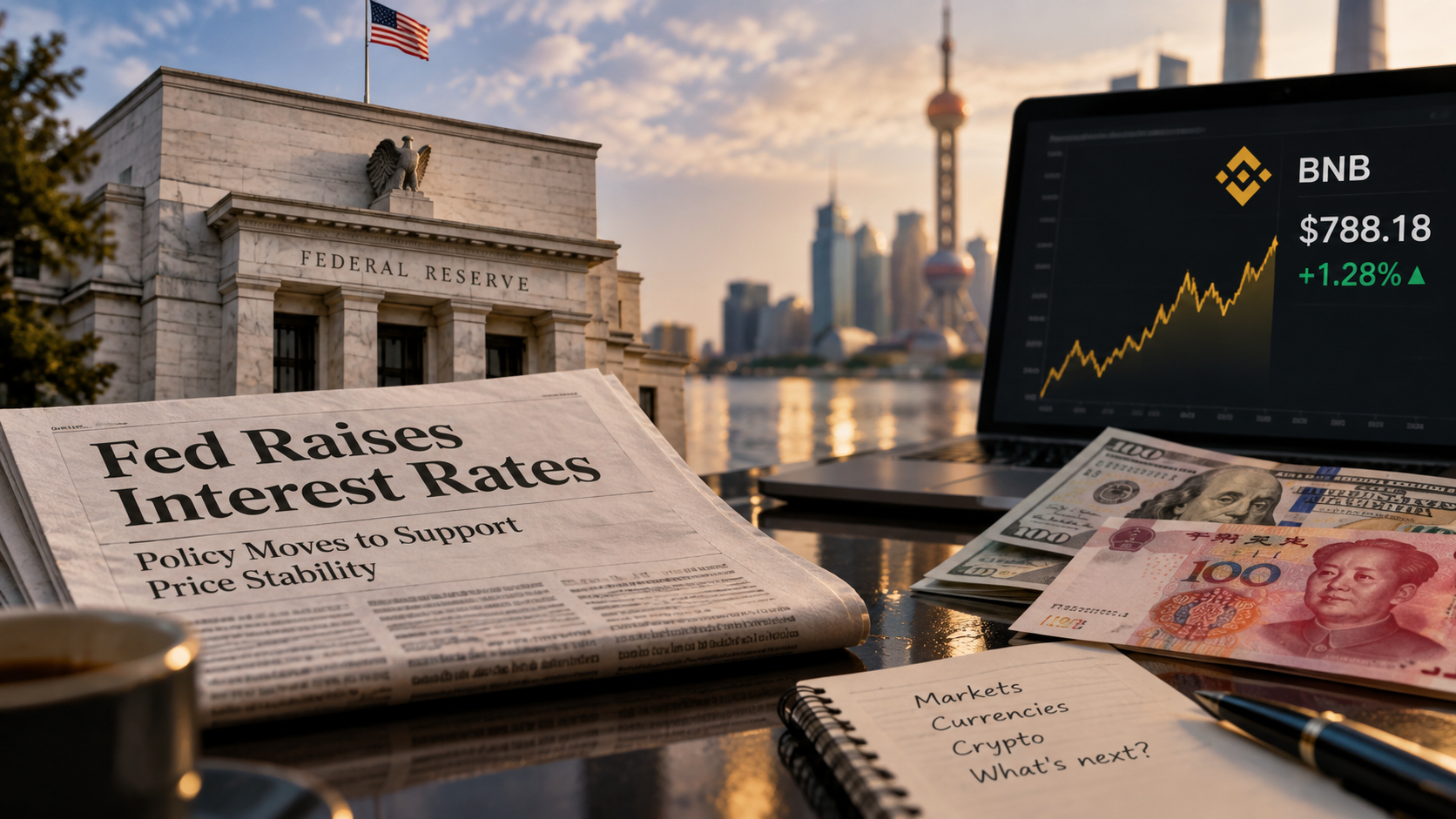
Today I saw a Reuters report saying that the RMB had strengthened to a more than three-and-a-half-year high against the U.S. dollar, just days after the Fed raised rates . My first reaction was a small sense of disappointment. For people who work in international trade and often receive payments in U.S. dollars, a slightly stronger dollar against the RMB is usually welcome news. When the Fed announced another rate increase, I had expected the exchange rate to move up at least a little. Instead, the market went almost the other way.
That made me want to look more closely at what had actually happened, especially because the currency market was not the only place behaving differently from what I had expected. In the same week, a major U.S. crypto market structure bill failed to advance in the Senate, the Federal Reserve raised rates for the first time in more than three years, and yet crypto prices began moving higher again. At first glance, none of this seemed to fit the simple market logic we often hear: higher U.S. interest rates should strengthen the dollar and put pressure on risk assets.
The reality turned out to be much more complicated.
The Fed raised rates for the first time in more than three years
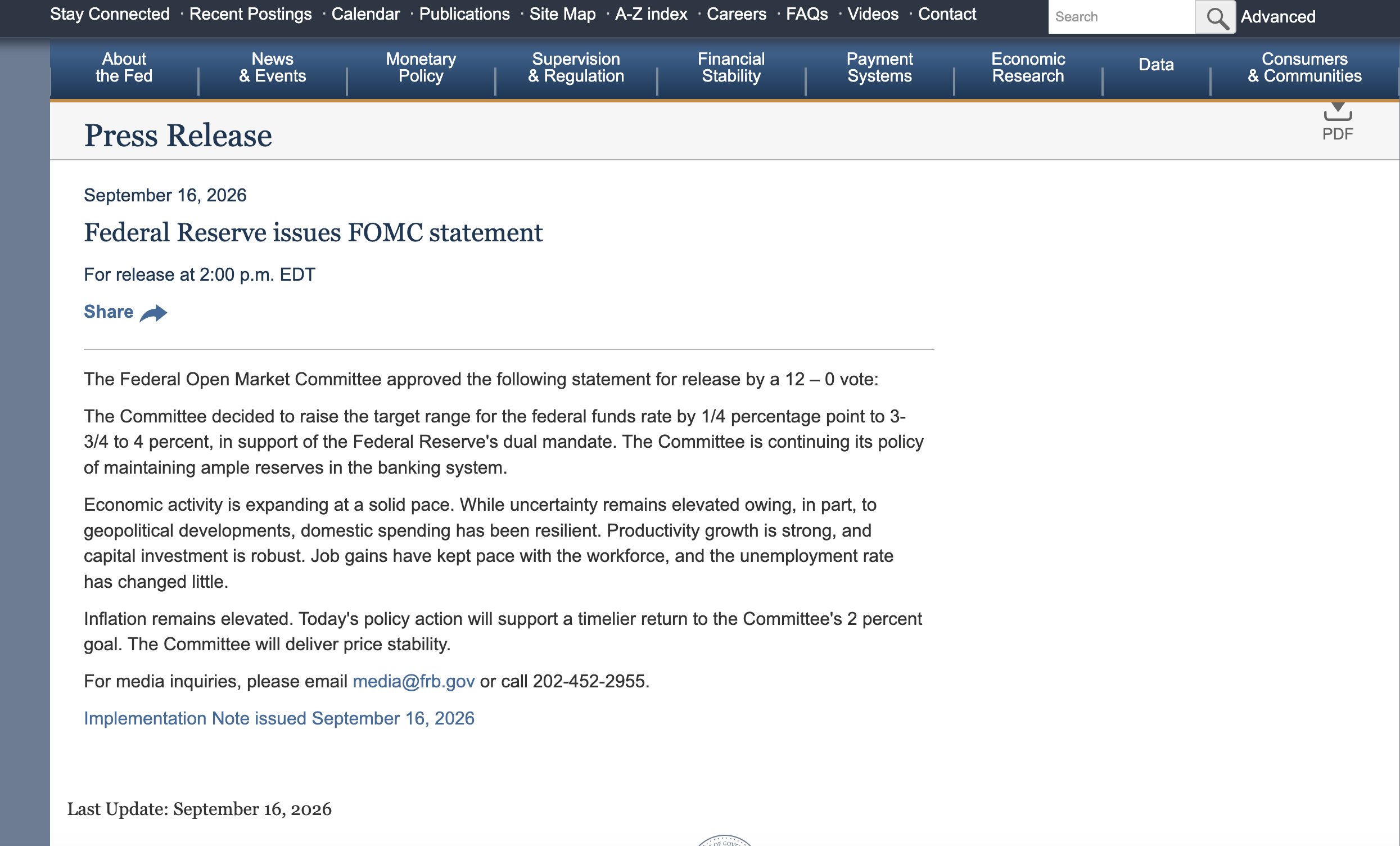
At its September meeting, the Federal Reserve raised the target range for the federal funds rate by 25 basis points to 3.75%–4.00% . The Fed said economic activity remained solid while inflation was still elevated, and that the move was intended to support a return toward its 2% inflation objective.
In the most basic economic model, higher U.S. interest rates can make dollar-denominated assets more attractive. That can support demand for the dollar, especially when rates elsewhere are lower, which is why people often associate Fed tightening with a stronger U.S. currency.
That was also the logic behind my own expectation. I was not expecting the dollar to jump suddenly, but I did think USD/CNY might rise modestly after the announcement.
Instead, the RMB became stronger.
Why did the RMB appreciate instead?
By September 21, the onshore yuan had strengthened to around 6.6950 per dollar, its strongest level in more than three and a half years. At the same time, the People’s Bank of China set the daily midpoint at 6.7487, the strongest fixing since February 2023. Reuters reported that the move came as the central bank appeared to be easing its previous resistance to RMB appreciation. (Reuters )
That distinction matters. The RMB did not strengthen because the Fed raised rates; it strengthened despite the Fed raising rates, because other forces affecting USD/CNY were strong enough to offset the usual interest-rate effect.
China’s exchange rate is not determined entirely by free-market trading. The PBOC sets a daily midpoint around which the currency is allowed to trade within a band, so changes in that fixing can send an important policy signal. Reuters noted that Chinese policymakers had spent much of the previous year leaning against overly rapid RMB appreciation, while that resistance appeared to have eased recently. (Reuters )
The timing adds another layer. The stronger RMB has come just ahead of the planned Trump–Xi meeting in the United States, which means trade expectations and broader policy stability are also part of the market backdrop. That does not mean the RMB was deliberately pushed higher for one meeting, but it does show why looking only at the Fed gives an incomplete picture. Currency markets are reacting to monetary policy, capital flows, trade expectations and political developments at the same time.
Crypto was even more interesting to me
I noticed something similar in crypto, although this time I was watching it through my own small BNB position.
On September 15, the U.S. Senate failed to advance the CLARITY Act, a major digital-asset market structure bill. The procedural vote fell short of the 60 votes required to move forward, and Bitcoin and crypto-related stocks dropped immediately after the result. (Reuters )
On paper, that looked like bad timing for crypto. Regulatory uncertainty had just increased, and the Fed was about to raise rates the next day. If I had followed the simplest version of the market narrative, I would have expected crypto to remain under pressure.
But that is not what I saw.
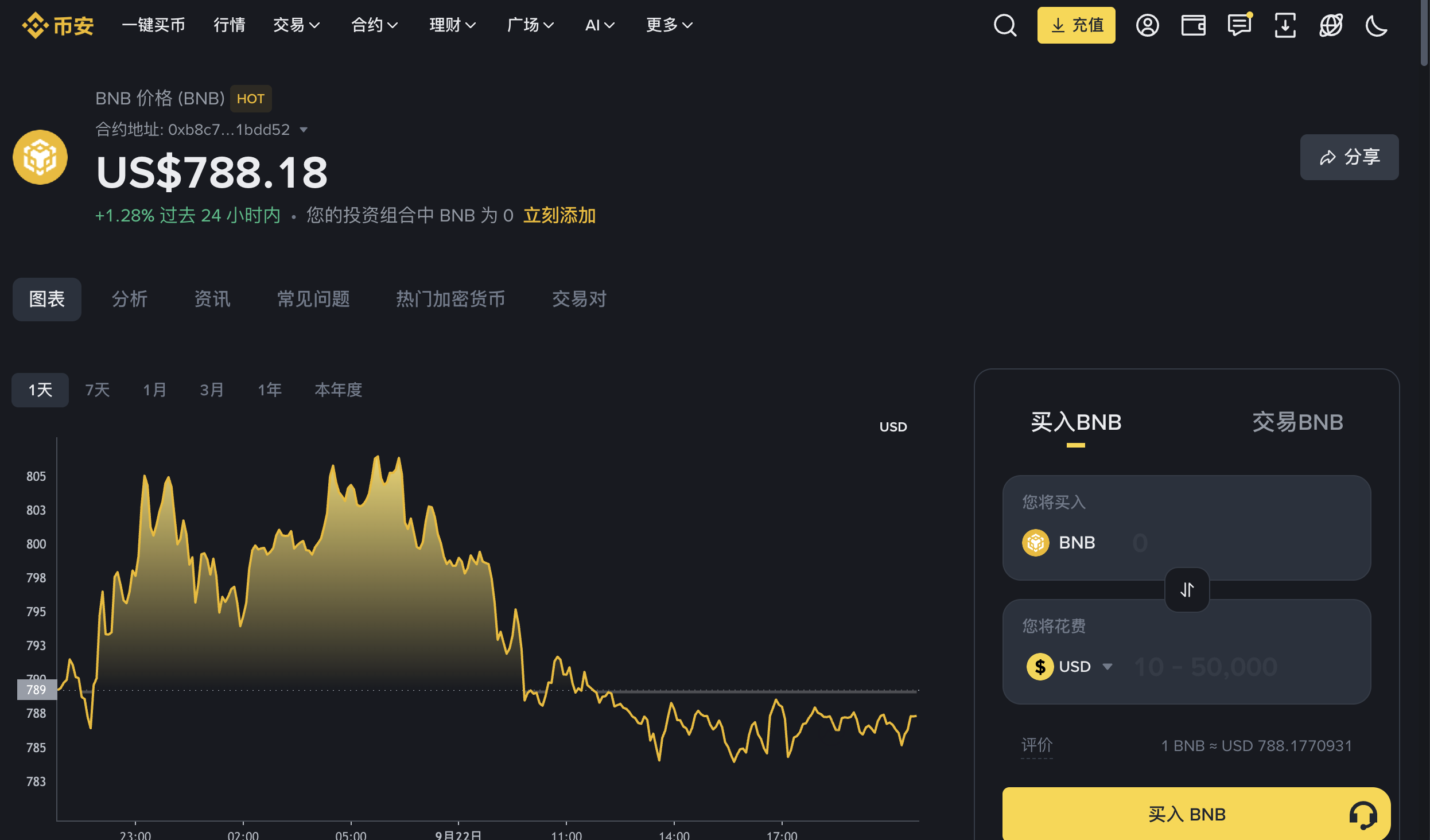
I have been slowly dollar-cost averaging into BNB, so I tend to notice its price even when I am not actively trading. On September 14, BNB was around $706 on the price level I was watching. Today, September 22, it is around $788. I am not using that move to predict where BNB goes next, but the change caught my attention because it happened during a week when two major headlines — a failed crypto bill and a Fed rate hike — both looked negative at first glance.
That is what made the market reaction more interesting to me than the price itself.
The failure of the CLARITY Act did trigger an immediate sell-off. Bitcoin fell after the Senate vote, and crypto-related equities also came under pressure. But the weakness did not last. By September 22, Bitcoin had climbed above $85,000, while broader crypto sentiment had improved again. Recent reporting has pointed to several factors behind that recovery, including renewed ETF inflows, easing bond yields and continued optimism around the direction of U.S. crypto regulation despite the failed vote.
In other words, the market did not ignore the bad news. It reacted to it first, then moved on.
Markets trade what happens next
This week reminded me of something that is easy to forget when reading financial headlines: markets rarely react only to the event that just happened.
By the time the Fed officially raised rates, the 25-basis-point move had already been widely expected. Reuters reported that the decision itself was largely in line with market expectations, even though the Fed’s tone remained hawkish and policymakers continued to signal that further tightening was possible.
So once the decision was announced, investors immediately started asking different questions: how many more hikes might follow, whether inflation would stay elevated, what bond yields would do next, and whether economic growth could remain resilient.
The same applies to crypto regulation. I wrote about the CLARITY Act and why the market was watching it so closely earlier this week. Its failure in the Senate was clearly a setback, but it did not mean the entire regulatory process stopped. The SEC and CFTC continue to shape digital-asset policy, and the bill itself could still be revisited later. The market therefore had to price not only the failed vote, but also what might happen after it.
That is probably why the same week could produce what looked like contradictory signals: the Fed raised rates, the RMB strengthened, a major crypto bill failed, and crypto prices still recovered.
They only look contradictory if we assume one headline should control the entire market.
What I am taking away from this week
My original expectation about USD/CNY was not unreasonable. Higher U.S. interest rates can support the dollar, and that relationship still matters. What I underestimated was how many other forces were moving at the same time.
For the RMB, the PBOC’s policy signals and China-specific expectations mattered. For crypto, the Fed mattered, but so did regulation, ETF flows, bond yields, liquidity and investor positioning.
I still watch the Fed closely, especially because I work internationally and the USD/RMB exchange rate has a very real impact on the money I eventually receive. I also still watch BNB because I am slowly buying it rather than trying to time one perfect entry.
But this week made me a little more careful about simple formulas such as “Fed hike means stronger dollar” or “higher rates mean crypto must fall.”
Those relationships exist. They are just never the whole story.
I started with a little disappointment that the dollar had not become more valuable against the RMB. Somehow, that turned into a few hours of reading about central-bank fixing policy, Senate votes and crypto market reactions.
Maybe that is a fair trade.
At least now I understand a little better why the market did not behave the way I expected.
This article is for informational purposes only and does not constitute financial advice.