
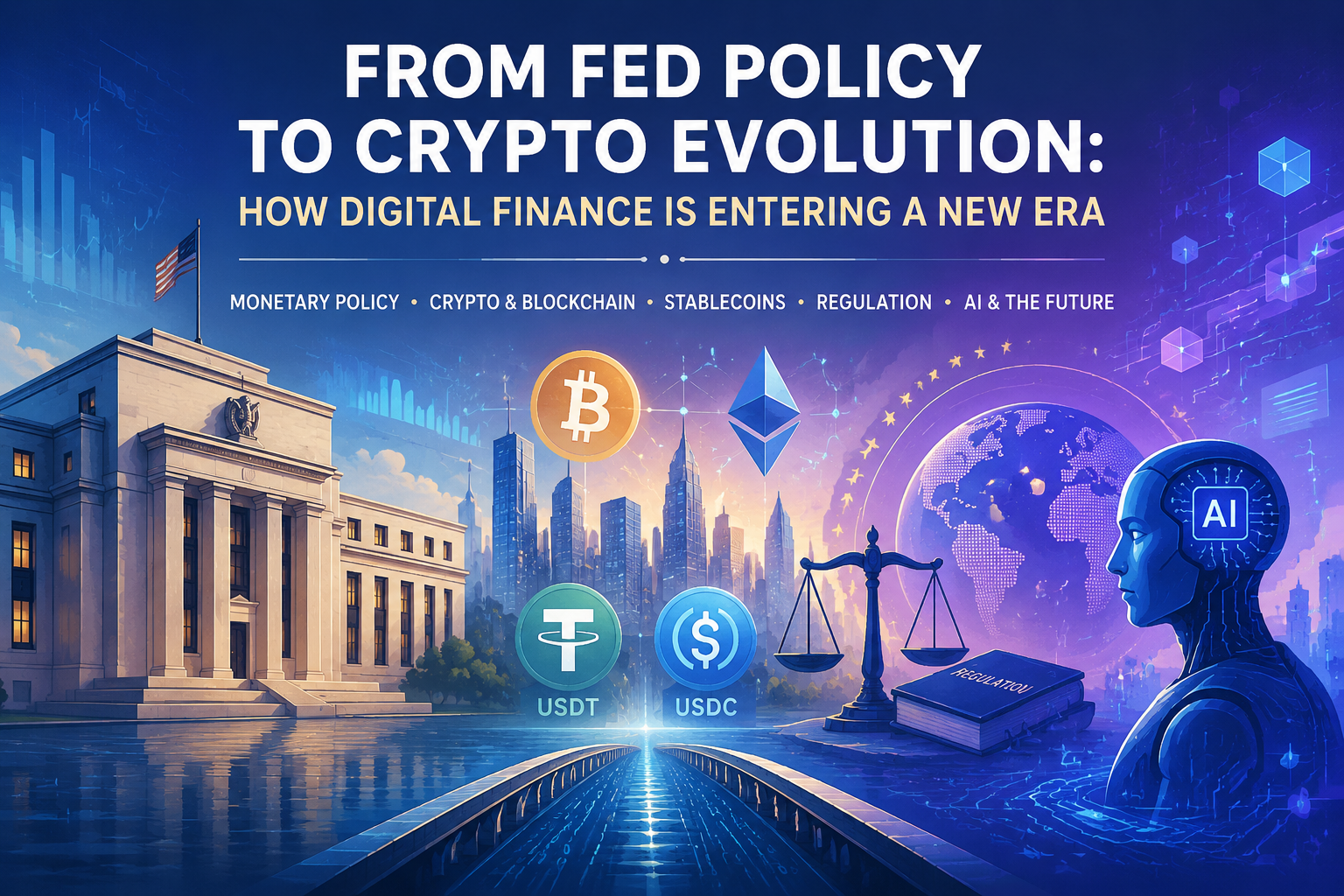
Over the past few years, the crypto industry has undergone a significant transformation.
In its early stages, crypto markets were largely driven by Bitcoin’s price movements and investment demand. Many users entered the market primarily because they saw digital assets as a new form of investment opportunity.
However, as blockchain technology has continued to develop, the focus of the industry has gradually shifted from individual asset prices toward broader digital asset ecosystems.
Today, the crypto market includes not only Bitcoin and Ethereum, but also stablecoins, decentralized finance (DeFi), real-world asset tokenization (RWA), blockchain-based payments, and emerging applications combining artificial intelligence with blockchain technology.
According to publicly available market data from platforms such as CoinMarketCap, the digital asset ecosystem has expanded from a Bitcoin-centered market into a broader financial and technology ecosystem involving multiple sectors and use cases.
At the same time, traditional financial institutions have become increasingly involved in digital assets. The approval of Bitcoin ETFs in major markets, the growth of institutional custody services, and the development of regulated digital asset platforms have gradually moved crypto beyond a niche technology experiment and into mainstream financial discussions.
Some industry observers describe this evolution through different stages. While terms such as Crypto 1.0, Crypto 2.0, and Crypto 3.0 are not official industry classifications, they are often used to describe the changing role of blockchain technology.
Crypto 1.0 is generally associated with Bitcoin and the emergence of decentralized digital money.
Crypto 2.0 represents the expansion of blockchain applications through smart contracts, decentralized applications, and programmable finance.
Crypto 3.0 is increasingly associated with the integration of blockchain technology with real-world economic activity, artificial intelligence, digital payments, and broader financial infrastructure.
Today, users, developers, and institutions are increasingly asking a different question.
The focus is no longer only on whether a particular cryptocurrency will rise in price, but whether blockchain technology can create sustainable value and become part of the next generation of digital financial infrastructure.
Recent developments in traditional finance and crypto regulation highlight this transition. The Federal Reserve’s monetary policy decisions and the global push toward clearer crypto regulatory frameworks are both influencing how digital finance may develop in the coming years. Similar discussions have emerged around recent U.S. financial policy developments, including how crypto and fintech companies may become increasingly connected with traditional financial systems .
While monetary policy determines the broader financial environment, regulation determines how digital assets can participate in the mainstream economy.
How Did Crypto Respond After the Latest Fed Meeting?
At the latest Federal Open Market Committee (FOMC) meeting, the Federal Reserve maintained its current interest rate policy and emphasized that future decisions would continue to depend on inflation trends, labor market conditions, and broader economic data.
As one of the world’s most influential central banks, the Federal Reserve’s monetary policy affects global liquidity conditions, investor sentiment, and risk appetite across financial markets.
When interest rates remain high, investors often become more selective and may prefer traditional assets with more predictable returns. Higher borrowing costs can also create pressure on risk assets, including technology stocks and digital assets.
However, after the latest Fed meeting, market reactions showed a more complex picture.
While foreign exchange markets experienced adjustments and the U.S. dollar weakened against some currencies, the crypto market demonstrated relative resilience. Major digital assets such as Bitcoin and Ethereum recorded moderate gains rather than experiencing significant declines.
This market behavior reflects an important shift in how investors view crypto.
In the past, crypto prices were often driven primarily by liquidity conditions and market sentiment. However, as the industry has matured, participants have increasingly focused on ecosystem development, institutional adoption, real-world applications, and regulatory progress.
In other words, crypto is gradually moving from a market driven mainly by speculation toward one increasingly influenced by long-term ecosystem value.
Why Does Fed Policy Still Matter for Crypto?
Although the crypto industry has continued to mature, it remains connected to the broader global financial system.
The Federal Reserve’s monetary policy influences dollar liquidity, capital flows, and investor risk preferences around the world.
A higher-rate environment can reduce demand for riskier assets, while expectations of future monetary easing may encourage investors to explore alternative growth opportunities, including technology innovation and digital assets.
However, interest rates mainly affect crypto’s short-term market performance.
Over the longer term, the value proposition of crypto increasingly depends on broader factors, including technological development, institutional participation, regulatory clarity, and real-world adoption.
The next stage of competition may not simply be about which token gains the most attention, but about which ecosystems can provide more effective financial infrastructure, payment solutions, and digital economic applications.
From Crypto 1.0 to Crypto 3.0: The Search for Real-World Utility
From an industry development perspective, the evolution of crypto can be understood as a transition from decentralized value transfer, to blockchain-based applications, and eventually toward broader digital financial infrastructure.
Although terms such as Crypto 1.0, Crypto 2.0, and Crypto 3.0 are not formal industry classifications, they provide a useful framework for understanding how the role of blockchain technology has changed over time.
Crypto 1.0 is commonly associated with Bitcoin.
When the Bitcoin network launched in 2009, it introduced a new approach to digital value transfer by allowing users to send and receive value through a decentralized network without relying on traditional financial intermediaries.
Bitcoin changed how people think about money, ownership, and digital scarcity, while also laying the foundation for the broader blockchain industry.
The next major stage came with Ethereum and the development of smart contract platforms.
Ethereum ’s mainnet launch in 2015 expanded blockchain beyond simple value transfers. Through smart contracts, developers could build decentralized applications (dApps), financial protocols, and digital asset systems directly on blockchain networks.
This development contributed to the growth of decentralized finance (DeFi), non-fungible tokens (NFTs), and other blockchain-based applications.
Today, the industry is increasingly focused on practical applications and ecosystem development.
Stablecoins are exploring new models for digital payments and cross-border transactions. Real-world asset tokenization (RWA) is attempting to connect traditional assets with blockchain networks. At the same time, artificial intelligence is creating new possibilities for blockchain-based economic activities.
Beyond financial applications, some projects are also exploring ways to make blockchain participation more accessible to everyday users.
For example, Pi Network represents one attempt to lower the barrier to blockchain participation through a mobile-first approach and community-driven ecosystem development. While opinions differ regarding its long-term adoption and utility, projects like this reflect a broader industry question: how can blockchain technology move beyond a market primarily focused on asset trading and become accessible to a wider user base?
As AI Agents become increasingly involved in digital economic activities, blockchain infrastructure may become an important connection between artificial intelligence and financial services. FlowAnRiver previously explored how AI and Web3 ecosystems are beginning to merge through new forms of digital interaction and automation.
In the future, AI Agents may use digital wallets to manage assets, use stablecoins for payments, and interact with smart contracts to execute automated transactions.
Therefore, the long-term direction of crypto may not simply be about creating new investment assets, but about building infrastructure that supports digital identity, automated commerce, programmable payments, and future internet services.
Stablecoins: The Bridge Between Crypto and Real-World Finance
If Bitcoin introduced a new approach to digital value storage, stablecoins are attempting to solve another fundamental challenge: digital value transfer and settlement.
For many years, crypto markets were primarily associated with assets such as Bitcoin and Ethereum. However, stablecoins have created a stronger connection between blockchain networks and real-world financial activities.
Stablecoins typically maintain their value by being backed by fiat currencies, financial assets, or other forms of reserves. Unlike highly volatile cryptocurrencies, stablecoins are designed to provide a more stable medium for transactions, payments, and financial applications.
According to publicly available market data, the stablecoin sector has grown into a market worth hundreds of billions of dollars and has become one of the most important components of the crypto ecosystem.
USDT issued by Tether and USDC issued by Circle currently represent two of the most widely used U.S. dollar stablecoins.
Tether has become the largest stablecoin issuer by market capitalization and publishes regular transparency reports detailing its reserve assets.
Circle’s USDC has focused heavily on regulatory compliance, transparency, and institutional adoption through reserve disclosures and cooperation with regulated financial systems.
The development of USDT and USDC demonstrates a broader shift within crypto.
Competition is no longer only about token prices.
It is increasingly about payment capability, regulatory compliance, financial connectivity, and ecosystem adoption.
Stablecoins and the Global Competition for Digital Finance
As stablecoins continue to grow, governments and financial institutions are increasingly recognizing that digital currency infrastructure may influence the future of global payments and financial competitiveness.
Stablecoins were once viewed mainly as trading tools within crypto markets. Today, they are increasingly discussed in relation to cross-border payments, financial settlement, and digital economic infrastructure.
The United States has maintained a leading position in the stablecoin market, particularly through dollar-based stablecoins. This development is closely connected to the global role of the U.S. dollar.
By establishing clearer stablecoin regulations, the United States aims to reduce financial risks while creating a framework that allows digital dollar innovation to develop.
At the same time, Europe, Japan, and major Asian financial centers are exploring their own approaches to digital assets and stablecoin development.
Europe: How MiCA Is Reshaping the Crypto Market
Europe has become one of the first major regions to introduce a comprehensive regulatory framework for crypto assets.
The Markets in Crypto-Assets Regulation (MiCA) aims to establish unified rules for crypto asset issuers, service providers, and market participants across the European Union. The European Commission describes MiCA as a regulatory framework designed to create harmonized rules for crypto assets across the EU.
Rather than simply restricting crypto activity, MiCA attempts to create a clearer environment where compliant companies can operate while consumers receive stronger protections.
For stablecoins, MiCA introduces stricter requirements related to authorization, reserve management, and transparency.
These requirements are already influencing the European crypto market.
Some stablecoins that do not meet European regulatory standards have faced restrictions on certain platforms, while compliant assets and services have gained greater attention.
For example, Circle has worked to align USDC and EURC with European regulatory requirements, while exchanges have adjusted their available stablecoin offerings for European users based on MiCA compliance considerations.
This development highlights an important trend:
The future competition among stablecoins will depend not only on market size, but also on regulatory compatibility.
Japan: Building a Regulated Framework for Digital Assets and Stablecoins
Japan has taken a relatively cautious but innovation-friendly approach toward crypto regulation.
The country was one of the earlier markets to establish regulatory requirements for crypto asset exchanges and has continued to develop a framework that focuses on both investor protection and technological innovation.
Through the Financial Services Agency (FSA), Japan has worked to create clearer requirements for digital asset businesses while exploring how blockchain technology can support future financial services. Japan’s Financial Services Agency provides regulatory information regarding crypto assets and virtual asset service providers.
In recent years, Japan has also shown increasing interest in stablecoins and blockchain-based payment systems.
Rather than viewing crypto as a replacement for traditional finance, Japan’s approach focuses on integrating digital assets into existing financial infrastructure through regulated channels.
This approach reflects a broader trend among developed economies: digital assets may become an additional layer of financial innovation rather than a complete replacement for traditional banking systems.
Singapore: Balancing Innovation and Risk Management
As a major financial hub in Asia, Singapore has actively explored opportunities in blockchain, digital assets, and financial technology.
The Monetary Authority of Singapore (MAS) has developed regulatory frameworks for digital payment token services under the Payment Services Act, requiring relevant companies to comply with licensing and risk management standards.
Singapore’s approach is not based on unrestricted crypto expansion.
Instead, the country aims to create a regulated environment where innovation can develop while financial risks are managed.
Through initiatives focused on digital finance, tokenization, and blockchain infrastructure, Singapore continues to position itself as a regional hub for compliant Web3 and fintech development.
This approach reflects a growing global trend:
Clear regulation may encourage innovation by creating more certainty for businesses, investors, and financial institutions.
China and Hong Kong: Different Paths Toward Digital Currency Development
China’s approach to digital assets differs significantly from that of the United States and some other markets.
Mainland China maintains strict restrictions on private cryptocurrency trading, while continuing to develop the digital yuan (e-CNY) as a state-led digital payment infrastructure.
Unlike market-based stablecoins such as USDT and USDC, the digital yuan represents a central bank-led approach to currency digitalization.
At the same time, Hong Kong has taken a different direction by developing a more open regulatory framework for virtual assets.
Through its Virtual Asset Service Provider (VASP) licensing system, Hong Kong aims to provide a regulated environment for digital asset platforms while maintaining financial market stability.
The different approaches across China and Hong Kong demonstrate that there is no single global model for digital finance development.
Different regions are experimenting with different frameworks:
The United States is focusing on market-based digital asset regulation.
Europe emphasizes unified rules and consumer protection.
Japan and Singapore prioritize regulated innovation.
China focuses on state-led digital payment infrastructure.
Hong Kong seeks to connect international finance with regulated digital asset markets.
From Uncertainty to Regulation: Global Crypto Frameworks Are Taking Shape
The United States is not the only country working to establish clearer crypto regulations.
As the crypto industry evolves from an asset trading market into a broader digital financial ecosystem, governments are increasingly focused on finding a balance between innovation, consumer protection, and financial stability.
One of the biggest challenges in the United States has been regulatory uncertainty, particularly regarding how different digital assets should be classified and which agencies should oversee them.
For years, discussions between the Securities and Exchange Commission (SEC) and the Commodity Futures Trading Commission (CFTC) regarding regulatory responsibilities have created uncertainty for businesses operating in the digital asset sector.
The CLARITY Act has attracted significant attention because it aims to provide a clearer market structure framework for digital assets.
The proposed framework focuses on issues such as:
- How different types of digital assets should be classified;
- The respective responsibilities of the SEC and CFTC;
- Regulatory requirements for digital asset platforms.
If clearer rules are established, traditional financial institutions, technology companies, and blockchain businesses may find it easier to participate in the digital asset economy.
However, regulation is unlikely to eliminate all risks.
The long-term challenge for policymakers will be finding the right balance between encouraging innovation and protecting users.
AI Agents and Crypto: Building the Next Digital Economy Infrastructure
Artificial intelligence is changing how digital services operate. From a practical perspective, the growing use of AI tools is also changing how individuals interact with technology and digital work .
In the future, AI Agents may move beyond simple information assistance and begin performing more complex economic activities, such as purchasing services, interacting with software tools, and executing automated transactions.
However, when AI systems begin participating in economic activities, new requirements will emerge around payments, identity verification, and asset management.
Traditional financial systems are generally designed around human-operated accounts and manual authorization processes.
AI Agents, however, may require financial infrastructure that is more automated, programmable, and capable of interacting directly with digital services.
This is one reason why digital wallets, stablecoins, and blockchain-based payment systems are receiving increasing attention.
If AI Agents eventually need to pay for software services, purchase digital resources, or execute business processes automatically, they may require payment systems that are fast, programmable, and globally accessible.
Stablecoins, smart contracts, and blockchain infrastructure are among the technologies being explored to support this potential future.
However, the combination of AI and crypto remains an emerging field. Its long-term development will depend on technological progress, regulatory clarity, security improvements, and real-world adoption.
The Future of Crypto Regulation and Digital Finance
Crypto regulation in the United States and globally remains an evolving process.
Stablecoin regulation has made significant progress, while broader market structure legislation continues to develop.
The discussion around the CLARITY Act reflects a larger question facing policymakers worldwide:
How can governments support digital innovation while maintaining financial stability and consumer protection?
In the short term, markets will continue watching regulatory developments, including how major economies define the future role of digital assets.
In the long term, the trend toward financial digitalization appears increasingly clear.
Regardless of how specific regulations evolve, digital assets, stablecoins, tokenization, and blockchain infrastructure are likely to remain important components of the future financial landscape.
Digital Finance Is Entering a New Competitive Era
Federal Reserve monetary policy influences the broader financial environment, while crypto regulation determines how digital assets can participate in the future economy.
From Bitcoin and smart contracts to stablecoins, AI Agents, and blockchain-based payments, the crypto industry is undergoing a transition from asset innovation toward infrastructure development.
The future competition in digital finance may not simply be about which cryptocurrency achieves the highest valuation.
Instead, it may be about which ecosystems can successfully connect artificial intelligence, blockchain technology, payment networks, and global financial systems.
The next stage of digital finance will likely be shaped by the interaction between monetary policy, regulatory frameworks, technological innovation, and real-world adoption.
Crypto, Stablecoins, and Digital Finance: Frequently Asked Questions
How does Fed policy affect crypto markets?
The Federal Reserve’s monetary policy influences global liquidity conditions, investor risk appetite, and capital flows. When interest rates remain high, investors may become more cautious toward risk assets. However, crypto markets are also influenced by ecosystem development, institutional adoption, regulation, and real-world applications.
Why are stablecoins important for digital finance?
Stablecoins provide a bridge between blockchain networks and traditional financial systems. Unlike highly volatile cryptocurrencies, stablecoins are designed to maintain relatively stable values and can support payments, cross-border transactions, digital settlements, and blockchain-based financial applications.
What is the difference between USDT and USDC?
USDT, issued by Tether, is currently one of the largest stablecoins by market capitalization and is widely used across global crypto markets. USDC, issued by Circle, focuses strongly on transparency, regulatory compliance, and institutional adoption.
Both play important roles in the crypto ecosystem, but they follow different approaches regarding reserves, compliance, and market positioning.
How is crypto regulation changing globally?
Crypto regulation is moving from uncertainty toward clearer frameworks.
The European Union has introduced MiCA to create unified rules for crypto assets, while countries such as Japan and Singapore have developed regulated approaches for digital asset services. The United States continues to discuss market structure legislation, including the CLARITY Act, to clarify regulatory responsibilities.
How could AI Agents use blockchain technology?
AI Agents may require automated systems for payments, identity verification, and digital asset management. Blockchain technology, digital wallets, smart contracts, and stablecoins are being explored as potential infrastructure for AI-driven economic activities.
However, the combination of AI and blockchain remains an emerging area, and long-term adoption will depend on technological development, security, and regulatory progress.
Disclaimer
This article is provided for informational and educational purposes only and does not constitute financial, investment, legal, or trading advice.
The cryptocurrency market involves significant risks, including price volatility, regulatory uncertainty, and potential loss of capital. Readers should conduct their own research and consider their individual circumstances before making any decisions related to digital assets.
Information regarding regulations, market conditions, and financial products may change over time. While we aim to provide accurate and up-to-date information, readers should verify important details through official sources and consult qualified professionals when necessary.